
Business
EPF vs PPF vs NPS 2026: Which Retirement Scheme Offers Better Returns, Tax Benefits and Pension?

EPF vs PPF vs NPS Retirement Planning 2026: Building a retirement fund is one of the most important financial goals for salaried employees, business owners and self-employed individuals. While regular income helps meet everyday expenses during working years, retirement requires a different financial strategy.
In India, three popular long-term savings options are the Employees' Provident Fund (EPF), Public Provident Fund (PPF) and National Pension System (NPS).
All three can help individuals accumulate money for retirement, but they differ in contribution rules, investment risks, returns, tax benefits and withdrawal conditions.
According to a Moneycontrol Hindi report published on November 5, 2026, understanding these differences can help investors choose suitable options based on their employment status, financial goals and risk tolerance.
EPF, PPF and NPS: Key Differences at a Glance
| Feature | EPF | PPF | NPS |
|---|---|---|---|
| Full name | Employees' Provident Fund | Public Provident Fund | National Pension System |
| Suitable for | Eligible salaried employees | Eligible individual savers | Salaried and self-employed individuals |
| Return | Government-declared interest | Government-notified interest | Market-linked |
| Rate used in examples | 8.25% | 7.1% | 10% assumed |
| Investment risk | Relatively low | Very low | Depends on asset allocation |
| Main purpose | Retirement savings | Long-term secure savings | Retirement corpus and pension planning |
| Tax treatment | Subject to applicable EPF rules | EEE benefits, subject to rules | Depends on contribution and withdrawal rules |
The rates and projections should not be interpreted as guaranteed future returns.
1. EPF: Retirement Savings for Salaried Employees
The Employees' Provident Fund is a retirement savings arrangement administered by the Employees' Provident Fund Organisation (EPFO).
It primarily covers eligible employees working in establishments governed by EPF regulations.
Under the standard contribution structure, employees contribute 12% of their applicable basic salary and dearness allowance.
Employers also contribute, although a portion of the employer's contribution may be directed towards the Employees' Pension Scheme (EPS).
The biggest advantage of EPF is that contributions are generally deducted automatically through payroll.
This helps employees build retirement savings without having to make separate investment decisions every month.
How Much Can You Save Through EPF?
Suppose an employee has a monthly basic salary and dearness allowance totalling ₹30,000.
At a contribution rate of 12%, the employee's monthly EPF contribution would be ₹3,600.
The employer's contribution would be calculated according to the applicable rules and contribution base.
For FY 2025-26, the EPF interest rate was 8.25%.
However, EPF contribution ceilings, pension allocations and tax provisions can affect the actual amount credited to an employee's provident fund account.
Employees should therefore review their salary slips and EPFO passbooks to understand their exact contributions.
2. PPF: Government-Backed Savings With Tax Benefits
The Public Provident Fund is a long-term savings scheme backed by the Government of India.
It is available to eligible resident individuals, including salaried employees, self-employed professionals and business owners.
PPF has a maturity period of 15 years, with provisions for extension.
The minimum annual contribution is ₹500, while the maximum permitted investment is ₹1.5 lakh per financial year.
For the October-December 2026 quarter, the PPF interest rate is 7.1% per annum.
Unlike market-linked investments, PPF returns are based on government-notified interest rates.
However, the rate can change from one quarter to another.
PPF Calculator: Invest ₹1.5 Lakh Annually for 15 Years
Suppose an investor contributes ₹1.5 lakh every financial year for 15 years.
The total amount invested would be ₹22.50 lakh.
Assuming the interest rate remains at 7.1% throughout the period, the maturity value could reach approximately ₹40.7 lakh under an illustrative contribution schedule.
| Particulars | Estimated Amount |
|---|---|
| Annual contribution | ₹1,50,000 |
| Investment duration | 15 years |
| Total investment | ₹22,50,000 |
| Assumed interest rate | 7.1% |
| Estimated maturity value | Around ₹40.7 lakh |
| Estimated interest earned | Around ₹18.2 lakh |
The actual maturity amount depends on the timing of deposits and interest rates applicable during the investment period.
PPF Tax Benefits
PPF is known for its favourable tax treatment.
Under the applicable rules, contributions may qualify for deductions under Section 80C in the old income-tax regime.
Interest earned and eligible maturity proceeds are generally exempt from income tax.
However, the Section 80C deduction is not available in the same manner under the new tax regime.
3. NPS: Market-Linked Retirement Investment With Pension Benefits
The National Pension System is a regulated retirement savings arrangement that invests contributions across different asset classes.
Depending on the chosen investment option, NPS funds may be allocated to equities, government securities, corporate bonds and other permitted investments.
Unlike EPF and PPF, NPS does not provide a fixed interest rate.
Returns depend on market performance, asset allocation, fund management and the investment period.
This creates the possibility of higher long-term returns, but also exposes investors to market fluctuations.
NPS Calculator: Invest ₹5,000 Monthly for 25 Years
Suppose an individual begins investing ₹5,000 per month at the age of 30.
If the person continues investing for 25 years, the total contribution will amount to ₹15 lakh.
Assuming an annualised return of 10%, the investment could grow to approximately ₹66 lakh, depending on the compounding method and contribution timing.
| Particulars | Estimated Amount |
|---|---|
| Monthly investment | ₹5,000 |
| Investment duration | 25 years |
| Total contribution | ₹15,00,000 |
| Assumed annualised return | 10% |
| Estimated retirement corpus | Around ₹66 lakh |
This is an illustrative projection. Actual NPS returns may be higher or lower.
NPS Withdrawal and Pension Rules
One important feature of NPS is the ability to use part of the accumulated retirement corpus to purchase an annuity.
An annuity is a financial product that can provide periodic income after retirement.
Under the revised NPS framework discussed in the source report, eligible non-government subscribers may be permitted to withdraw up to 80% of the accumulated corpus as a lump sum, subject to applicable conditions, while using at least 20% for annuity purchase.
However, withdrawal requirements can differ depending on the subscriber category, exit circumstances and applicable regulations.
Government-sector subscribers may be subject to different conditions.
The tax treatment of withdrawals and annuity purchases must also be considered separately. A higher permitted lump-sum withdrawal does not automatically mean the entire withdrawal is tax-free.
EPF vs PPF vs NPS: Which Offers Better Returns?
Each option has a different return structure.
EPF offers a declared interest rate and benefits from employer contributions where applicable.
PPF provides government-backed savings with a notified interest rate and favourable tax treatment.
NPS offers market-linked growth potential, but returns are not guaranteed.
Illustrative annual return rates
EPF and PPF rates are stated reference rates; NPS is an assumed return, not a declared interest rate.
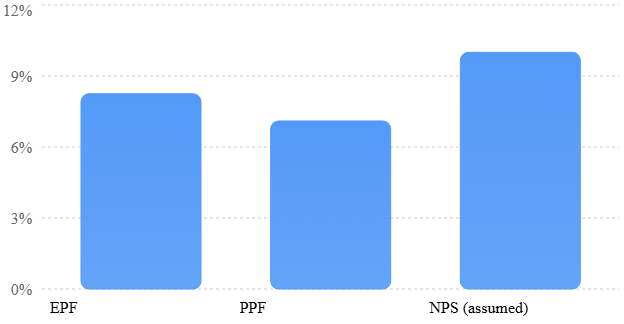
These figures should not be used as a direct performance ranking because EPF and PPF have declared interest rates, whereas NPS performance depends on market conditions.
Which Retirement Option Should Salaried Employees Consider?
For employees whose employers contribute to EPF, the scheme can serve as an important foundation for retirement savings.
Employer contributions add to the overall benefits available through the arrangement, subject to pension allocations and statutory rules.
Employees seeking additional government-backed savings may consider PPF.
Those with a longer investment horizon and the ability to tolerate market fluctuations may also evaluate NPS for retirement-oriented investing.
The appropriate combination depends on income, financial responsibilities, existing retirement benefits and investment objectives.
Can You Invest in EPF, PPF and NPS Together?
Yes. Eligible individuals can hold investments across all three arrangements, subject to the rules governing each scheme.
For example, a 30-year-old salaried employee may already be contributing to EPF through payroll.
The employee could additionally invest in PPF for relatively stable long-term savings and allocate another portion of available income to NPS for market-linked retirement accumulation.
Using multiple retirement savings arrangements may help diversify the sources of retirement income.
However, diversification does not eliminate investment risk, and investors should consider liquidity requirements before committing substantial amounts to long-term products.
Important Tax Considerations Before Choosing
Tax treatment is an important factor when comparing EPF, PPF and NPS.
EPF contributions and withdrawals are governed by specific income-tax provisions, including conditions related to eligible service periods and taxable interest on certain employee contributions.
PPF generally offers tax-exempt interest and eligible maturity proceeds.
NPS provides deductions under applicable provisions, including Section 80CCD, subject to limits and the chosen tax regime.
Employer contributions to NPS may receive separate tax treatment.
Because tax rules can change, investors should verify the provisions applicable to their financial year and tax regime.
Conclusion
EPF, PPF and NPS serve different retirement planning needs.
EPF is particularly relevant for eligible salaried employees because of regular payroll deductions and employer contributions.
PPF offers a government-backed long-term savings option with favourable tax treatment.
NPS provides exposure to market-linked investments and can support retirement income planning through annuity arrangements.
Rather than focusing only on projected returns, investors should evaluate contribution requirements, investment risk, liquidity, taxation and retirement income needs.
A retirement plan that balances stable savings with suitable long-term growth opportunities may help individuals prepare more effectively for life after employment.
Disclaimer: This article is for general financial awareness. Interest rates, tax benefits and withdrawal rules are subject to change. Investment projections are illustrative and do not guarantee future returns. Consult a qualified financial adviser before making investment decisions.


