
Business
8th Pay Commission in Jaipur: Fitment Factor and Salary Revision Take Centre Stage in Key Talks
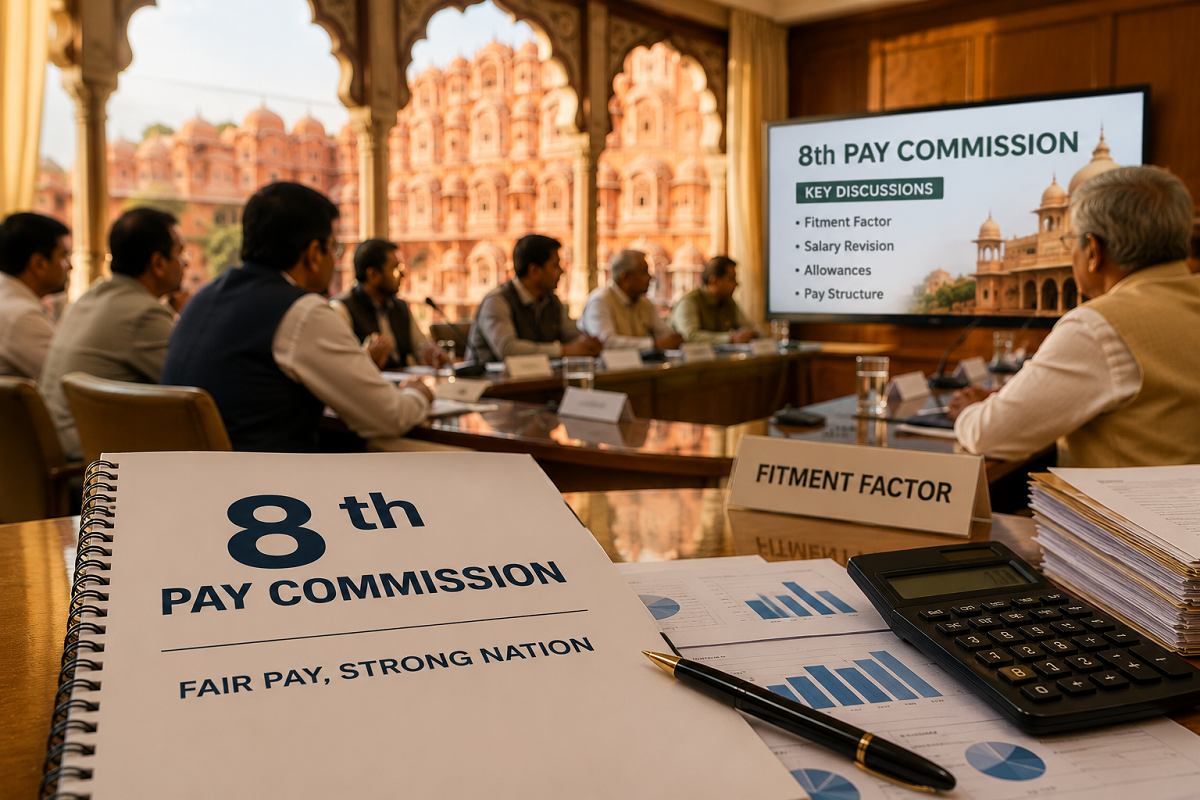
Central government employees and pensioners waiting for clarity on their next salary and pension revision are closely watching Jaipur, where the 8th Central Pay Commission is holding an important round of stakeholder consultations.
The Commission's two-day visit to Jaipur, Rajasthan, began on August 31 and continues through September 1, 2026. During these consultations, representatives of employee associations, federations, unions and other eligible stakeholders are getting an opportunity to present their concerns and recommendations directly before the panel.
Among the issues drawing the greatest attention are the fitment factor, basic salary revision, allowances, annual increments and pension benefits.
However, employees should keep one crucial point in mind: no final fitment factor or salary hike has been announced yet. The Jaipur meetings are part of the consultation process, and the Commission will consider stakeholder submissions before preparing its recommendations.
8th Pay Commission Holds Two-Day Consultation in Jaipur
The 8th Central Pay Commission officially scheduled its Rajasthan visit for August 31 and September 1, 2026.
According to the Commission's official notice, the Jaipur consultations are intended for associations, federations and unions representing Central Government and Union Territory employees that are located or registered in Rajasthan.
Eligible organisations were required to submit their requests for an interaction by August 18. The Commission had also specified that participating organisations should have already submitted their memorandum and received a unique Memo ID.
The Jaipur exercise forms part of the Commission's broader consultation programme through which it is gathering suggestions from employees, pensioners and other stakeholders before framing the next pay structure.
Why the Fitment Factor Is Getting So Much Attention
The fitment factor is expected to remain one of the biggest talking points surrounding the 8th Pay Commission because of its potential impact on revised basic salaries.
Under the previous pay commission, a fitment factor of 2.57 was used when transitioning to the 7th Pay Commission structure. The minimum basic pay consequently moved from ₹7,000 under the earlier system to ₹18,000.
Government employee organisations are now seeking a considerably higher factor under the 8th Pay Commission. Some prominent unions and federations have reportedly pushed for a fitment factor above 3.5.
But these figures remain demands and proposals, not an approved formula.
The Commission has not officially announced what fitment factor it will recommend, and the government has not approved any final number.
What Could a 3.5 Fitment Factor Mean for Basic Pay?
A hypothetical calculation illustrates why employees are paying such close attention to this number.
If the existing minimum basic salary of ₹18,000 were simply multiplied by a 3.5 fitment factor, the mathematical result would be ₹63,000.
Similarly, an employee currently receiving a basic pay of ₹35,400 would get a mathematical figure of ₹1,23,900 when multiplied by 3.5.
For a current basic salary of ₹56,100, the corresponding calculation would reach ₹1,96,350.
These numbers, however, should not be interpreted as confirmed future salaries. Actual revised basic pay will depend on the fitment methodology, pay matrix design and recommendations ultimately adopted by the government.
Salary Growth Could Involve More Than the Fitment Factor
Another important issue emerging in discussions around the 8th Pay Commission is how salaries should grow after the new pay structure is introduced.
Employee organisations have expressed different views on annual increments. Recent discussions have included proposals for higher yearly increments, with one federation advocating a 7% annual increment while some other major employee organisations have supported a 6% increase.
This debate matters because a fitment factor primarily influences the transition from the existing pay structure to a new one, while annual increments determine how an employee's basic salary grows over subsequent years.
Therefore, employees are watching both issues rather than focusing solely on the initial fitment factor.
Pensioners Are Also Closely Watching the Jaipur Consultations
The 8th Pay Commission is not important only for serving employees. Pensioners also have a major financial stake in its recommendations.
Pensioner organisations have been raising demands related to pension revision, parity and retirement benefits.
In a significant development reported on September 1, the Department of Personnel and Training (DoPT) has referred demands concerning revision of pensions for past pensioners to the Department of Expenditure.
The representations involve organisations including the All India Defence Employees' Federation and pensioner groups.
However, this development should also be understood as part of the ongoing deliberative process rather than a final government decision on revised pensions.
DA and Allowances Will Also Matter
While basic pay and the fitment factor attract the most attention, an employee's final salary is influenced by several other components.
Dearness Allowance, House Rent Allowance, Transport Allowance and other benefits can significantly affect monthly earnings.
The treatment of existing DA when the new pay structure is implemented will therefore be closely watched.
The Commission will need to consider multiple factors while developing its recommendations, including inflation, prevailing salary structures, economic conditions and the government's financial position.
Until those recommendations are released, calculations circulating around salary increases should be treated as estimates rather than guaranteed benefits.
8th Pay Commission Was Formed in November 2025
The Government of India formally constituted the 8th Central Pay Commission on November 3, 2025.
The Commission is chaired by Justice Ranjana Prakash Desai. Professor Pulak Ghosh serves as a part-time member, while Pankaj Jain is the Member-Secretary.
The Commission has been given an 18-month period to complete its work.
This means its final recommendations are currently expected around May-June 2027, although the actual salary revision will ultimately depend on the Commission's report and subsequent decisions taken by the Central Government.
More Regional Consultations Are Planned
Jaipur is not the end of the Commission's consultation exercise.
The official schedule shows that meetings are also planned in other parts of the country. Consultations in Chennai are scheduled for September 7-8, followed by Puducherry on September 9.
The Commission is also scheduled to visit Chandigarh from September 16 to 18, while another consultation programme is planned in Bengaluru for October 7-8.
These regional meetings allow employee organisations and other eligible stakeholders to place their demands and suggestions before the Commission.
What Should Central Government Employees Expect Next?
The Jaipur meetings are important, but they should not be confused with an announcement of the new salary structure.
At this stage, the 8th Pay Commission is collecting and examining representations. Once consultations and analysis are completed, the panel will prepare its recommendations covering areas such as salaries, allowances and pensions.
Those recommendations will subsequently go before the government for consideration.
Therefore, there is currently no officially confirmed 8th Pay Commission fitment factor, minimum basic salary or percentage salary hike.
The Bottom Line
The 8th Pay Commission's Jaipur consultations on August 31 and September 1 represent another important step toward determining the future salary and pension framework for Central Government employees and pensioners.
Fitment factor, basic pay revision, annual increments, allowances and pension benefits are among the issues attracting considerable attention during the consultation phase.
Employee organisations may push for higher fitment factors and better salary growth, but the final numbers are still awaited. For now, employees and pensioners should distinguish between stakeholder demands and officially approved recommendations.
The Jaipur discussions could help shape the Commission's eventual proposals, but the actual financial impact will become clear only after the 8th Pay Commission submits its report and the Central Government takes a final decision.