
Business
Bank Savings Account Rules 2026: Key RBI and Government Decisions Every Account Holder Should Know
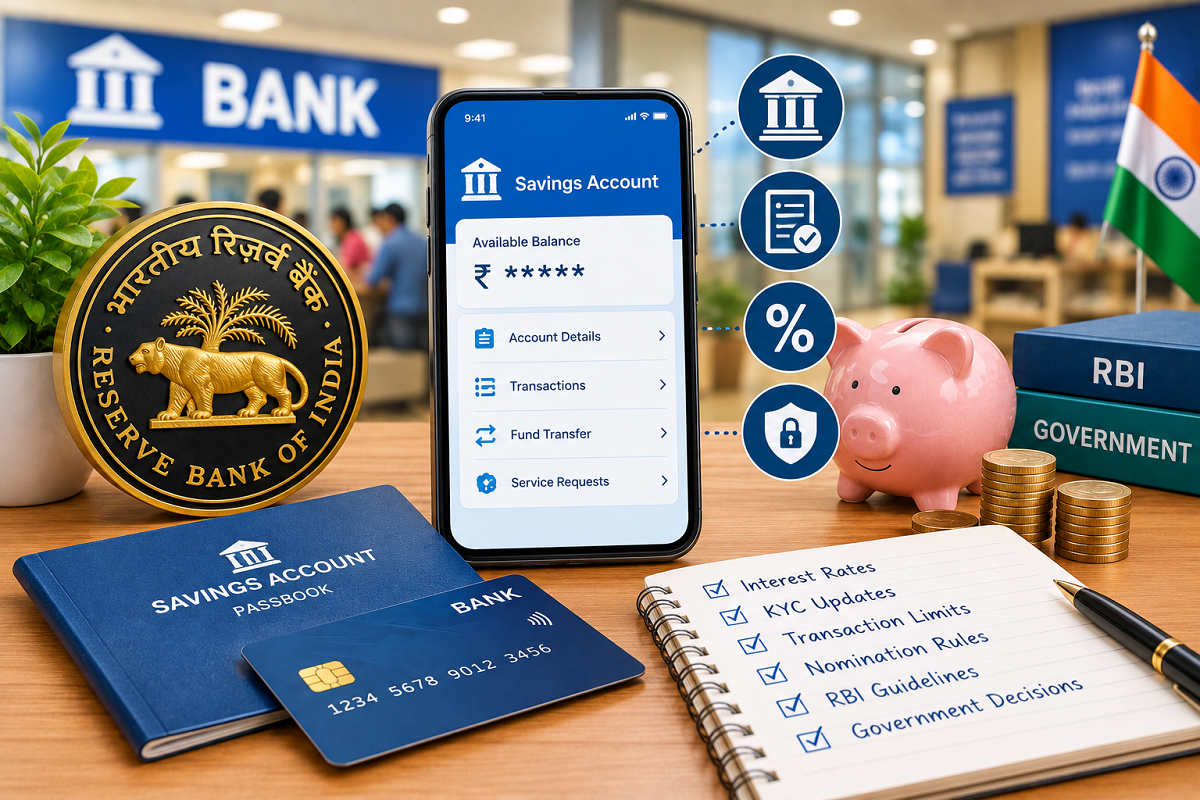
Bank Savings Account Rules 2026: Savings accounts are among the most widely used banking products in India, with millions of customers relying on them for salaries, pensions, government benefits, UPI payments and everyday transactions. Over time, the government and the Reserve Bank of India (RBI) have introduced several measures aimed at improving transparency, customer protection and access to banking services.
These rules are important because even small issues related to minimum balance requirements, inactive accounts, nomination, KYC or service charges can affect account holders. Understanding the applicable banking rules can help customers avoid unnecessary charges and manage their accounts more effectively.
Minimum Balance Rules: What Customers Should Know
One of the biggest concerns for savings account holders is the requirement to maintain a minimum balance.
There is no single minimum balance requirement applicable to every savings account across all banks. The requirement can depend on the bank, type of account and applicable terms.
Some savings accounts may require customers to maintain a specified average balance, while certain basic savings accounts can operate without such a requirement.
Customers should therefore check the terms of their specific savings account rather than assuming that the same minimum balance rule applies everywhere.
Banks Must Be Transparent About Charges
Transparency regarding banking charges is another important aspect of customer protection.
Banks may levy charges for certain services according to their policies and applicable regulations. These could include charges associated with particular account services, ATM usage beyond permitted limits, cheque-related services or other facilities.
Customers should have access to the applicable schedule of charges so they can understand how much a service will cost before using it.
Whenever banks revise important charges or account conditions, customers should pay attention to official communications received from their bank.
Basic Savings Accounts Can Help Customers Avoid Balance Requirements
Customers looking for essential banking services without maintaining a minimum balance can explore eligible basic savings account options.
A Basic Savings Bank Deposit Account (BSBDA) is designed to provide basic banking facilities subject to the applicable conditions.
Such accounts can be particularly useful for customers who need essential banking services without the burden of maintaining a high balance.
However, customers should understand the facilities, transaction conditions and other terms applicable to the specific account before opening one.
Inoperative and Dormant Accounts: Don't Ignore Them
A savings account that remains unused for an extended period may be classified as inoperative under applicable banking rules.
Having an inoperative account does not mean that the customer's money simply disappears. However, the customer may need to complete the bank's prescribed process to reactivate the account and resume normal transactions.
If you have an old savings account that you have not used for a long time, check its status with the bank rather than leaving it unattended.
Reactivating an Inoperative Account
Banks may require customers to complete verification before an inoperative account can be fully activated again.
The process may involve updating KYC information and completing customer identification requirements, depending on the account and circumstances.
Customers should contact their bank through an official branch, website, mobile application or customer-care channel to understand the exact procedure.
Avoid agents or unknown individuals who ask for money, OTPs or banking passwords in the name of activating a dormant account.
KYC Details Should Be Kept Updated
Know Your Customer (KYC) requirements play an important role in banking security and regulatory compliance.
Customers should ensure that information such as their name, address, PAN and other required KYC details is accurate and updated whenever necessary.
Banks may periodically ask customers to update or reconfirm KYC information according to applicable rules.
Always complete KYC through authorised banking channels and never share OTPs or sensitive credentials with someone claiming they can update KYC remotely on your behalf.
Nomination Is Important for Savings Accounts
Adding a nominee is an important step that many customers overlook.
A nomination can make the settlement process easier for the nominee or legal heirs if the account holder dies. Customers should check whether a nomination has been registered on their savings account and whether the information remains correct.
If your personal or family circumstances have changed, review your nomination details and update them through the bank's authorised process where necessary.
What Happens to Money in an Unclaimed Account?
Money lying in an account does not automatically become the bank's property merely because the account has remained unused for years.
There are regulatory mechanisms dealing with long-unclaimed deposits. Customers or eligible claimants can follow the prescribed process to locate and claim such deposits.
If you or a family member had an old bank account that has not been operated for years, it may be worthwhile to check whether any unclaimed balance remains.
Savings Account Interest Is Also Important
Banks generally pay interest on eligible balances maintained in savings accounts according to the applicable rate and calculation method.
Interest rates can differ from one bank to another and may change over time.
Customers should not assume that every bank provides the same savings-account interest rate. If you maintain a large balance, checking the applicable interest rate and account conditions can help you manage your money more effectively.
Digital Banking Security Remains Crucial
With UPI, mobile banking and internet banking becoming part of everyday life, protecting savings accounts from fraud has become increasingly important.
Never share your OTP, UPI PIN, ATM PIN, CVV or internet banking password with another person.
Banks and RBI do not require customers to disclose confidential PINs or passwords over phone calls or WhatsApp messages.
Be especially cautious about messages claiming that your bank account will be blocked immediately unless you click a link and complete KYC.
What Savings Account Holders Should Do
Account holders should periodically review their savings accounts instead of waiting for a problem to occur. Check whether your KYC and contact details are updated, verify nomination information, understand the minimum balance requirement applicable to your account and review the bank's latest schedule of charges.
Old or unused accounts should also be checked. If you no longer need an account, consider following the bank's official closure process rather than leaving it unused indefinitely.
Regularly reviewing account statements can also help detect unauthorised transactions at an early stage.
Final Takeaway
Banking regulations and customer-protection measures are intended to make savings accounts more transparent, accessible and secure. However, there is no single new rule that applies identically to every savings account. Minimum balance requirements, interest rates and certain service conditions can vary depending on the bank and account type.
Savings account holders should therefore check the terms applicable to their own bank account, keep KYC and nomination details updated, monitor old accounts and remain alert to digital banking fraud.
Disclaimer: This article is for general informational purposes only. Banking regulations, account conditions, charges, KYC requirements and interest rates may change. Customers should verify the latest rules through their bank and official RBI or government communications before taking any financial decision.