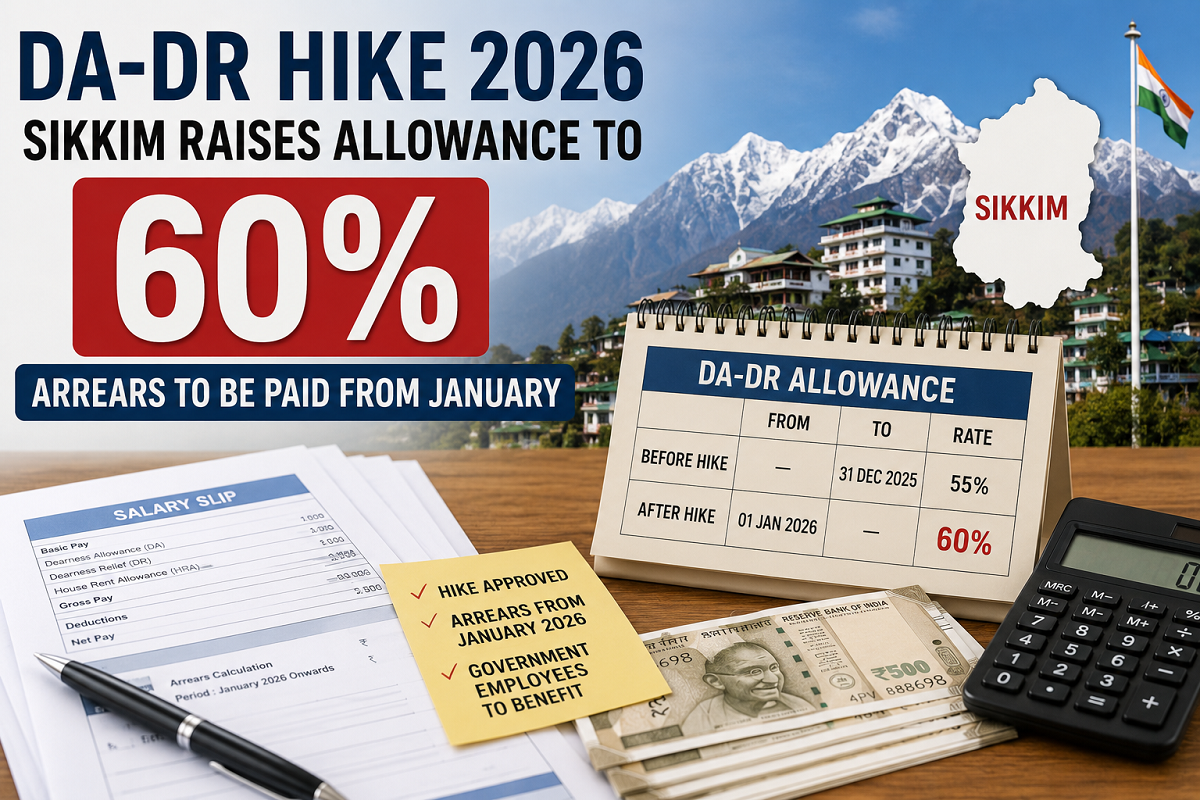
DA-DR Hike 2026: Government employees and pensioners in Sikkim are set to receive higher inflation-linked benefits after the state government announced a 2% increase in Dearness Allowance (DA) and Dearness Relief (DR). With this revision, the applicable rate will rise from 58% to 60%.
The increase will be effective retrospectively from January 1, 2026, which means eligible employees and pensioners will also receive arrears for the intervening months. The pending amount is expected to be cleared before the 2026 Dashain festive period.
The announcement provides additional financial support at a time when rising living costs continue to affect household budgets.
Sikkim Announces 2% Increase in DA and DR
Sikkim Chief Minister Prem Singh Tamang announced the revision during the Independence Day programme held at Paljor Stadium in Gangtok on August 15.
Before the latest revision, eligible state government employees and pensioners were receiving DA and DR at the rate of 58%. Following the 2-percentage-point increase, the rate will now stand at 60%.
The decision will benefit serving government employees as well as eligible retired employees covered under the state's pension framework.
Higher DA Will Apply From January 1, 2026
One of the most important parts of the announcement is the retrospective effective date.
The revised DA and DR rate will be treated as applicable from January 1, 2026 rather than from the date of the announcement.
This means employees will be entitled to the difference between the old and revised rates for the months that have already passed.
Pensioners will similarly receive the corresponding DR arrears based on their basic pension.
According to the announced timeline, the state government intends to clear the arrears before the Dashain festival, providing employees and pensioners with an additional payout ahead of the festive season.
How Much Extra Money Will Employees Get?
The actual increase in monthly income will not be the same for every employee.
DA is calculated as a percentage of basic pay. Therefore, employees with a higher basic salary will receive a larger absolute increase.
For example, if an employee has a basic salary of ₹40,000 per month, a 2% DA increase would translate into an additional:
₹40,000 × 2% = ₹800 per month
An employee with a basic salary of ₹60,000 would receive an additional ₹1,200 per month.
The same principle applies to pensioners, although DR is calculated on eligible basic pension.
DA and DR: What Is the Difference?
Dearness Allowance and Dearness Relief serve broadly the same purpose but apply to different groups.
Dearness Allowance (DA) is paid to serving government employees to help offset the impact of inflation on their salaries.
Dearness Relief (DR) is the corresponding benefit paid to government pensioners.
Both are typically calculated as a percentage of basic salary or basic pension.
Whenever the government raises the DA or DR rate, the monthly payout increases in proportion to the employee's or pensioner's basic amount.
Why Are DA Revisions Important?
Inflation gradually reduces the purchasing power of fixed income.
Government employees may see the cost of food, fuel, housing and other essentials rise even when their basic salary remains unchanged.
DA is designed to partially compensate for this increase in living costs.
For pensioners, DR serves a similar purpose because retirees may depend heavily on pension income for regular expenses.
When DA or DR is revised retrospectively, beneficiaries receive not only the higher monthly amount going forward but also the accumulated difference for earlier months.
Central Government Employees Have Also Seen DA Revision
The source article also states that the Centre has approved a 2% increase in DA and DR, taking the rate for eligible central government employees and pensioners from 58% to 60%, effective from January 1, 2026.
The Centre generally revises DA and DR twice a year, with changes linked to the January and July cycles.
The January 2026 revision has already been announced, while employees are now watching for the next revision linked to the July 2026 cycle.
Any further increase would depend on the applicable inflation data and an official government decision.
Railway Employees Also Covered by DA Revision
Railway employees and pensioners are also covered by central government DA and DR revisions under the applicable rules.
This means eligible railway staff and retired employees will receive the benefit of the revised rate in line with the central government's implementation orders.
The exact payment schedule may depend on departmental processing and payroll instructions.
Several States Have Also Revised Allowances
Apart from Sikkim, a number of state governments have announced or implemented DA revisions for their employees.
According to the source article, Arunachal Pradesh, Assam, Odisha, Tamil Nadu and Uttar Pradesh are among the states where a 2% increase has been announced.
West Bengal has also announced a separate DA revision under its own structure.
Since every state follows its own pay and allowance framework, employees should check the official order issued by their respective government rather than assuming that the same rate applies nationwide.
How Arrears Can Increase the One-Time Payout
When a DA increase is implemented retrospectively, the accumulated amount can result in a sizeable one-time payment.
Suppose an employee receives ₹1,000 extra per month because of a 2% DA increase and the revision is applied from January.
If arrears are released after several months, the employee may receive the accumulated difference for the entire eligible period in addition to the revised monthly salary.
The same calculation principle applies to pensioners receiving DR.
Actual arrears will depend on basic pay or pension and the number of months covered.
What Sikkim Employees Should Check
Eligible employees and pensioners should watch for the detailed government order specifying the revised rate, effective date, arrears calculation and payment timeline.
The final amount credited to an individual may vary depending on basic pay, pension, service category and applicable deductions.
Employees should therefore refer to their salary slip or departmental order once the revised allowance is reflected.
Bottom Line
The latest DA-DR revision in Sikkim raises the rate from 58% to 60%, providing additional financial support to eligible government employees and pensioners.
Since the increase takes effect from January 1, 2026, beneficiaries will also be entitled to arrears for the previous months. The pending amount is expected to be released before the Dashain festive period.
For government employees, the revision means a higher monthly salary component. For pensioners, it means increased Dearness Relief. The exact benefit will depend on the individual's basic pay or basic pension.
Disclaimer: DA and DR rates, arrears schedules and implementation details are subject to official government notifications. Employees and pensioners should verify the final figures through the relevant state or central government order and their respective department.