
Business
EPF After Retirement: Where to Invest Your Corpus for Regular Monthly Income and Long-Term Stability
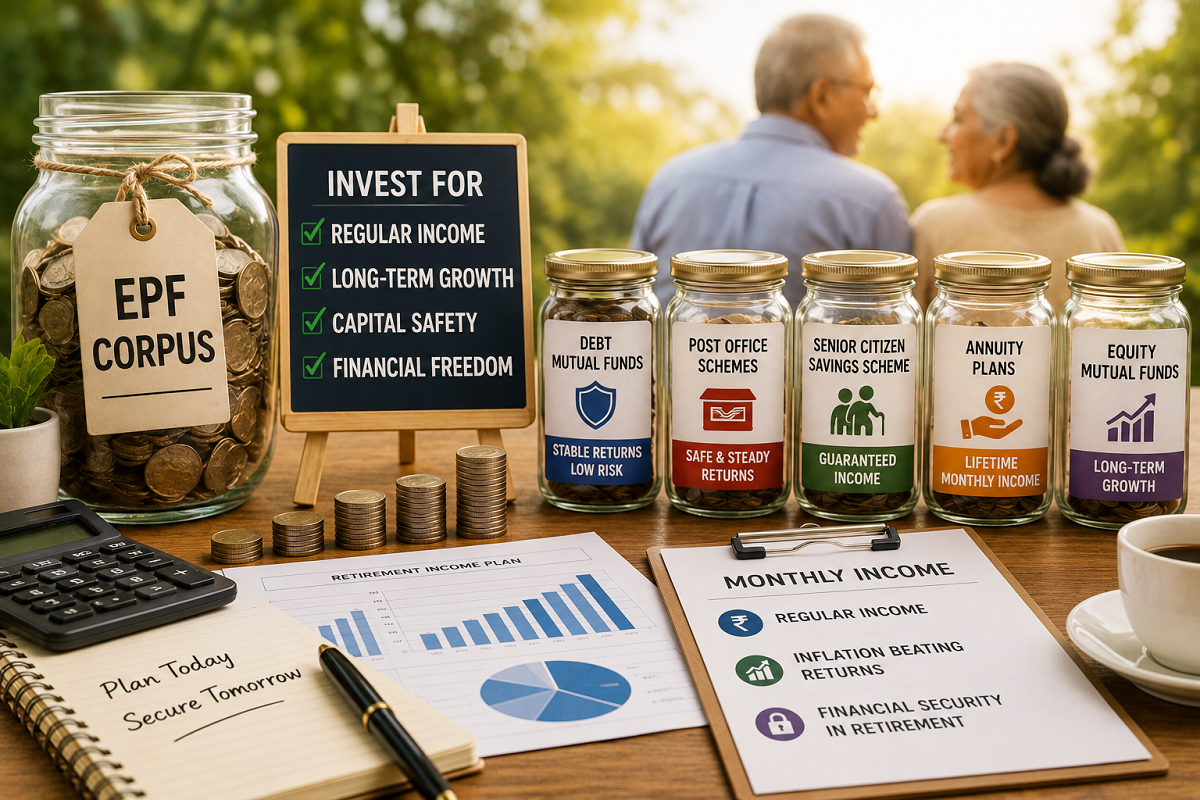
EPF Retirement Planning: The money accumulated in an Employees' Provident Fund can become one of the most important financial assets after retirement. Once a regular salary stops, however, retirees face a new challenge: how to convert a large retirement corpus into a dependable income stream without taking excessive risk.
Keeping the entire amount in one place may appear safe, but retirement planning usually requires a balance between capital protection, regular income, liquidity and growth. Inflation can gradually reduce purchasing power, so a retirement portfolio may need both fixed-income products and a limited growth component.
The right allocation depends on age, monthly expenses, medical needs, existing pension income and risk tolerance. Here are some options retirees can consider while planning how to use their EPF corpus.
How Long Does EPF Continue to Earn Interest After Retirement?
Many employees assume that their EPF balance will continue earning interest indefinitely after they stop working. That is not always the case.
The treatment of interest can depend on the member's age, employment status and the applicable EPFO rules. Therefore, retirees should not build their entire post-retirement plan on the assumption that an inactive EPF account will keep earning the same rate forever.
Before leaving a large balance in EPF for several years, members should verify the current rules applicable to their account and retirement age through official EPFO channels.
This is especially important because retirement planning often covers 20 to 30 years or even longer.
Should You Keep the Entire EPF Corpus in One Investment?
For most retirees, concentrating the entire retirement fund in a single product may not be ideal.
A good retirement portfolio usually has to perform several jobs at the same time. Part of the money should provide predictable income, some should remain liquid for emergencies, and another portion may need to grow enough to counter inflation.
Diversification can help create this balance.
Instead of placing the full EPF withdrawal into one fixed deposit or one market-linked product, retirees can divide the corpus according to different financial needs.
1. Senior Citizens' Savings Scheme for Regular Income
The Senior Citizens' Savings Scheme, or SCSS, is one of the commonly considered options for eligible retirees seeking relatively stable income.
It is a government-backed small-savings scheme and pays interest at the rate notified for the relevant period.
For retirees who want predictable cash flow and are comfortable with the scheme's tenure and investment limits, SCSS can form part of the fixed-income portion of a retirement portfolio.
However, investors should check the latest interest rate, maximum investment limit, premature withdrawal rules and tax treatment before investing.
2. Bank Fixed Deposits Can Provide Predictable Cash Flow
Bank fixed deposits remain another familiar option for retirees.
Many banks offer monthly, quarterly or other periodic interest payout choices, which can help retirees match investment income with household expenses.
Senior citizens may also receive a higher interest rate than general customers, depending on the bank.
Instead of placing the entire corpus into one long-term FD, some retirees use an FD ladder by dividing the money across deposits with different maturity dates.
This can improve liquidity and reduce the risk of locking the entire amount at one interest rate.
Investors should also consider deposit insurance limits and avoid concentrating very large sums in a single institution purely for convenience.
3. Debt Mutual Funds Can Add Liquidity
Debt mutual funds may be considered by retirees who want greater flexibility than traditional fixed deposits.
These schemes invest in debt securities and can offer easier access to money when required. However, they are not the same as bank deposits and do not offer guaranteed returns.
Their value can fluctuate because of changes in interest rates, credit conditions and the type of securities held by the fund.
Retirees considering debt funds should therefore pay attention to credit quality, duration risk, taxation and the specific category of the fund rather than treating all debt schemes as equally safe.
Should Retirees Keep Some Money in Equity?
Retirement does not necessarily mean that every rupee must be removed from equity.
A retirement period can last for decades, and inflation can significantly reduce the real value of savings over such a long period.
For this reason, some investors may choose to retain a limited allocation to diversified equity, index or hybrid funds.
The objective is usually not aggressive short-term returns but long-term growth that can help preserve purchasing power.
However, equity exposure should depend on the retiree's ability to tolerate market falls without being forced to sell investments for monthly expenses.
A retiree with sufficient pension and fixed-income cash flow may be able to hold a higher equity allocation than someone who depends entirely on the investment corpus.
Example: How a ₹3 Crore Retirement Corpus Could Be Divided
A diversified structure can help illustrate how different investments may serve different purposes.
For example, a ₹3 crore retirement corpus might be divided approximately as follows:
| Investment Bucket | Illustrative Allocation |
|---|---|
| EPF, SCSS, FDs and other fixed-income options | 40%–50% |
| Debt funds or other debt instruments | 30%–35% |
| Diversified equity, index or hybrid funds | 15%–20% |
| Emergency cash or highly liquid savings | Around 5% |
This is only an illustration and should not be treated as a universal recommendation.
A 60-year-old retiree with substantial pension income may require a very different allocation from a 70-year-old retiree who depends fully on investments for monthly expenses.
Why an Emergency Fund Is Essential
A retirement portfolio should not force an investor to sell long-term investments whenever an unexpected bill appears.
Keeping around 6 to 12 months of essential expenses in highly accessible savings can provide a financial buffer.
Medical expenses, home repairs and family emergencies often occur without warning. If adequate liquid money is available, retirees are less likely to break long-term deposits or sell market-linked investments during an unfavourable period.
The emergency fund should therefore be treated separately from long-term investments.
How to Build a Monthly Income Strategy
A retiree does not necessarily need every investment to pay monthly interest.
A better strategy can be to create separate buckets.
One bucket can cover near-term expenses through cash, savings accounts, short-term deposits and predictable-income products.
Another bucket can hold medium-term debt investments.
A third bucket can remain invested for long-term growth.
This structure can reduce the pressure to chase high-yield products purely because they promise monthly payouts.
Retirees should focus on whether the overall portfolio can sustainably meet expenses rather than selecting investments only on the basis of headline interest rates.
Be Careful About High-Return Retirement Products
A large EPF payout can attract aggressive sales pitches.
Retirees should be cautious about products promising unusually high guaranteed monthly income, especially if the investment structure is difficult to understand.
Before investing, check whether the product is regulated, whether returns are guaranteed or market-linked, what the lock-in is, what happens on early exit and whether large commissions are involved.
Capital protection is particularly important after retirement because recovering from a major investment loss can be difficult once salary income has stopped.
Inflation Must Be Part of the Plan
A monthly expense of ₹60,000 today may be significantly higher a decade later.
This is why planning only for today's expenses can create a retirement shortfall.
A portion of the portfolio may need to grow faster than inflation over the long term. This is where limited exposure to growth assets can become useful.
At the same time, retirees should not take more risk than they can tolerate merely to beat inflation.
The goal is balance, not maximum return.
Review the Portfolio Every Year
Retirement planning should not be a one-time exercise.
Interest rates change, medical expenses rise, family circumstances evolve and market conditions fluctuate.
An annual portfolio review can help retirees rebalance between fixed income, debt, equity and cash.
If equity rises sharply and becomes too large a portion of the portfolio, some gains can be moved back into safer assets. If fixed-income maturities are approaching, future cash-flow needs can be reviewed before reinvestment.
Five Practical Rules After Retirement
Retirees can keep a few simple principles in mind:
- Avoid placing the entire EPF corpus in one product.
- Use predictable-income options for essential monthly expenses.
- Keep sufficient liquidity for emergencies.
- Maintain only as much market-linked exposure as your risk capacity allows.
- Review the portfolio and cash-flow needs at least once a year.
Bottom Line
The EPF corpus can play a major role in financial security after retirement, but the way it is deployed matters just as much as the amount accumulated.
Instead of relying on one investment, retirees can consider a combination of government-backed schemes, bank deposits, debt investments, emergency cash and limited equity exposure.
The ideal mix should be based on expected monthly expenses, pension income, medical requirements, tax position and investment horizon.
The objective after retirement is not to chase the highest possible return. It is to make sure the money lasts, provides dependable income and retains enough growth potential to handle inflation over many years.
Disclaimer: This article is for general information only and should not be treated as personalised investment advice. EPF interest rules, small-savings rates, tax provisions and investment regulations can change. Retirees should verify current rules and consider consulting a SEBI-registered investment adviser or qualified financial planner before making major retirement-investment decisions.