
Business
Free Ration e-KYC Guide: Which App to Use and How to Complete Aadhaar Verification From Home
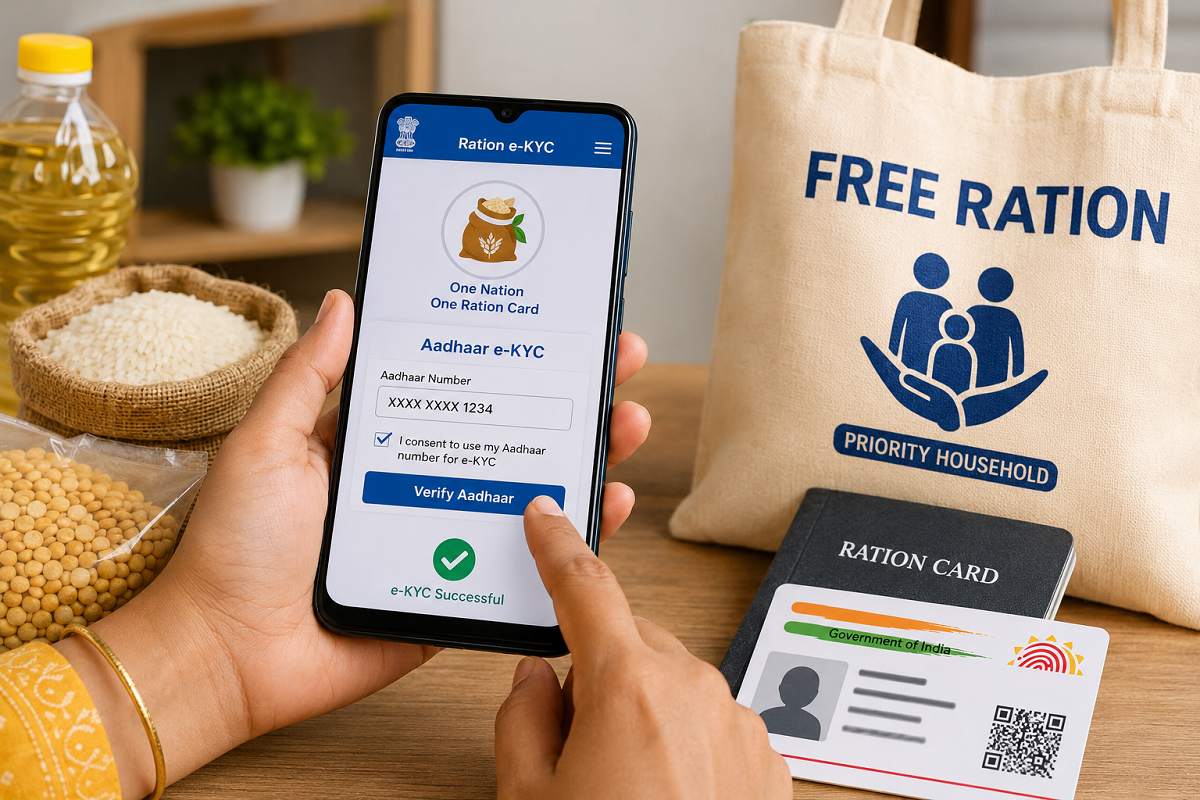
Ration card beneficiaries may need to complete e-KYC to continue accessing eligible food-security benefits smoothly. Here’s how mobile-based Aadhaar verification works, which apps may be required and what to do if online e-KYC is unavailable.
Millions of households across India depend on government food-security programmes for their monthly ration entitlement. For beneficiaries, keeping ration card records updated has become increasingly important as authorities use Aadhaar-based verification to authenticate eligible family members and improve the delivery of benefits.
Beneficiaries whose ration card e-KYC is still incomplete should check the requirements applicable in their state or Union Territory. Failure to complete mandatory verification could create difficulties in receiving benefits until the required authentication is completed.
At the same time, beneficiaries should note that the availability of online e-KYC is not identical across India. Mobile-based verification may work in participating states and Union Territories, while people in other areas may need to visit their local Fair Price Shop (FPS) or ration dealer.
What Is Changing for Some Ration Beneficiaries?
A digital payment-based system is being used for eligible beneficiaries in certain Union Territories, including Chandigarh and Dadra and Nagar Haveli and Daman and Diu.
Under the arrangement, Central Bank Digital Currency, commonly known as the Digital Rupee or e₹, can be used for transferring eligible food subsidy benefits through a digital wallet.
The Digital Rupee is the Reserve Bank of India's digital form of currency. It can be stored and used through supported e₹ wallets offered by participating banks.
This means beneficiaries covered by such an arrangement may receive the applicable benefit digitally and use the wallet while making eligible transactions.
However, consumers should not assume that every ration card holder across India must download a Digital Rupee app to continue receiving ration. The process depends on the scheme and system implemented in the beneficiary's location.
Which App Is Needed for the Digital Rupee Wallet?
Beneficiaries covered by a CBDC-based subsidy system generally need to use a supported Digital Rupee wallet.
Participating banks provide their own official e₹ or Digital Rupee applications. Beneficiaries should check which bank or authorised service provider is linked to the programme applicable to them and download only its official app.
Once the wallet is activated and the applicable benefit is credited, transactions can be made using supported QR-code payment facilities.
Users should avoid downloading applications through links received from unknown numbers, social-media posts or unsolicited messages. Using only official app stores and verified banking applications can reduce the risk of fraud.
Which Apps Are Used for Ration Card e-KYC?
Where mobile-based ration card e-KYC is supported, beneficiaries may be able to complete Aadhaar authentication using the Mera eKYC application along with the Aadhaar FaceRD app.
Aadhaar FaceRD supports facial authentication by using the smartphone camera to verify the beneficiary's identity.
Since online facilities can differ by state, beneficiaries should first check whether mobile e-KYC is available in their region.
If the service is unavailable, they can use the offline biometric verification option at an authorised ration outlet.
How to Complete Ration Card e-KYC Using Your Phone
Start by installing the required official applications, including Mera eKYC and Aadhaar FaceRD, where the facility is supported.
Open the Mera eKYC application and select your state or Union Territory. Enter the information requested on the screen and provide your Aadhaar number when required.
An OTP may be sent to the mobile number linked with Aadhaar. Enter the OTP to complete the initial authentication.
After verification, choose the Face e-KYC or facial authentication option.
Position your face correctly in front of the smartphone camera and follow the instructions displayed on the screen. Good lighting and a stable internet connection may help the facial authentication process.
Once the face is successfully matched with Aadhaar records, the e-KYC request can be completed.
Beneficiaries should check the final status shown in the application to ensure that the verification has been successfully processed.
What If Face e-KYC Fails?
A failed mobile verification does not necessarily mean that a beneficiary cannot complete e-KYC.
Face authentication may sometimes fail because of poor lighting, camera quality, connectivity problems or discrepancies in the information being submitted.
If repeated attempts do not work, beneficiaries can visit their nearby Fair Price Shop or authorised ration dealer and request biometric e-KYC.
Fingerprint or other supported biometric authentication can then be used to verify the beneficiary's Aadhaar identity.
This alternative is also useful for people who do not own smartphones or are uncomfortable completing the process digitally.
Is Online Ration Card e-KYC Available Everywhere?
No. Beneficiaries should remember that online ration card e-KYC facilities may not be uniformly available across every state and Union Territory.
The procedure can also change depending on local implementation. Therefore, instructions that work for a beneficiary in one state may not necessarily apply in exactly the same way elsewhere.
If the online option does not appear or the app does not support a particular location, beneficiaries should contact their ration dealer or the relevant state food and civil supplies department rather than repeatedly attempting authentication through unofficial services.
Keep Aadhaar and Ration Card Details Updated
Completing e-KYC helps authorities authenticate beneficiaries and maintain accurate ration card records. It can also reduce problems caused by outdated or mismatched beneficiary information.
Ration card holders should check whether all eligible family members requiring verification have completed the process, rather than assuming that verification of only one member automatically completes the requirement for everyone.
Most importantly, beneficiaries should rely on official government, Aadhaar, bank and state food department channels for e-KYC and Digital Rupee-related instructions. Aadhaar OTPs, banking passwords, PINs and other confidential information should never be shared with unknown individuals claiming they can complete ration card verification on the beneficiary's behalf.