
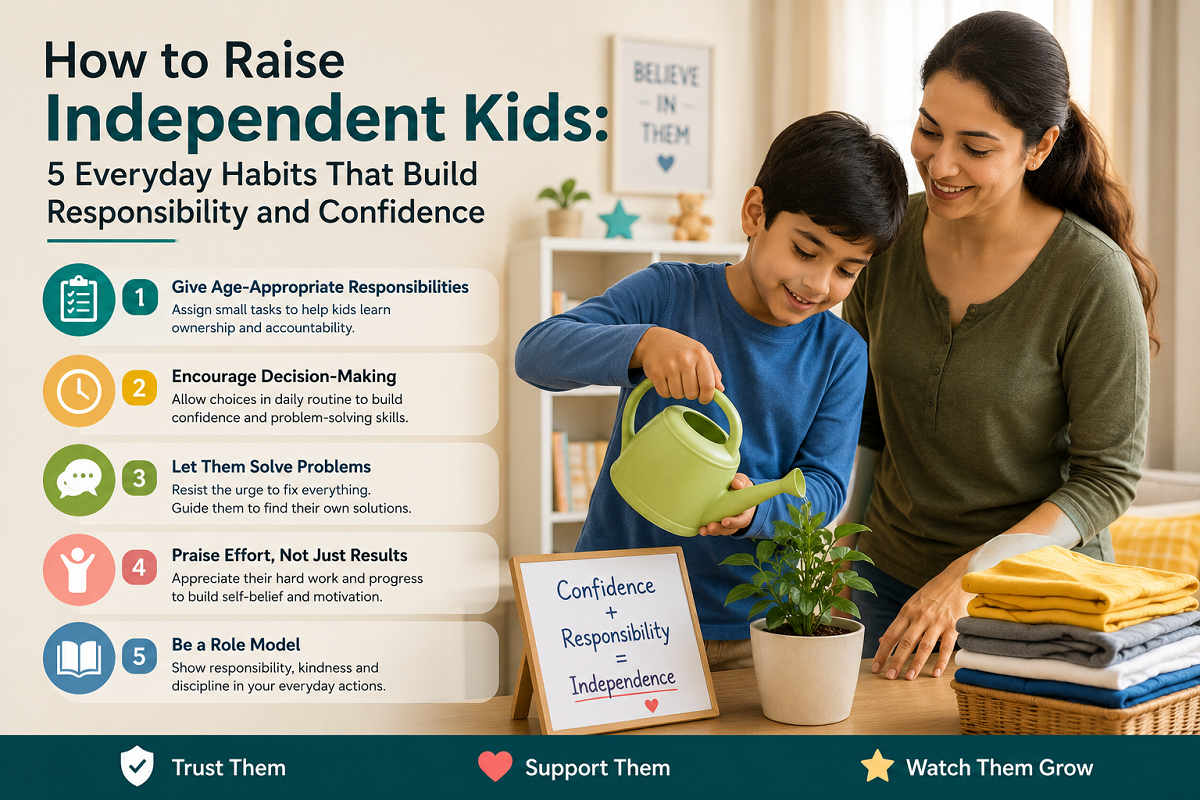
Parenting Tips for Independent Children: Every parent wants their child to grow into a responsible, confident and capable adult. But responsibility does not develop overnight. Children usually learn it gradually when they are given age-appropriate freedom, small duties and opportunities to make decisions on their own. Simple everyday habits at home can help children become more independent without making them feel unsupported.
Parents often step in quickly when a child struggles with getting ready, completing homework, cleaning a room or solving a small problem. While this may save time in the moment, doing everything for children can unintentionally increase their dependence on adults.
A more balanced approach is to guide children, supervise when necessary and gradually allow them to handle routine tasks themselves. The goal is not to leave them alone with responsibilities beyond their age, but to build practical life skills step by step.
Here are some everyday habits parents can encourage to help children become more self-reliant.
Let Children Get Ready for School on Their Own
A useful place to begin is the morning routine.
Children can gradually be taught to wake up on time, brush their teeth, get dressed and prepare for school with less parental assistance. Younger children may initially need reminders, but the level of support can be reduced as they become comfortable with the routine.
Parents can also encourage them to check their school timetable and pack their own bag.
This does more than save parents time. It teaches children to plan ahead, remember what they need and take responsibility for their belongings.
If a child forgets a notebook occasionally, parents do not always need to rush in and solve the situation immediately. Small, manageable mistakes can become useful learning experiences.
Give Them Responsibility for Their Own Space
Another simple way to encourage independence is to involve children in keeping their room or study area organised.
After waking up, they can be encouraged to arrange their bed according to their age and ability. Books that have been taken out can be returned to the shelf, toys can go back into their basket and the study table can be cleared after use.
These tasks may seem small, but they help children understand that maintaining a clean and organised environment is a shared responsibility.
Parents can initially turn the activity into a routine rather than treating it as punishment. Over time, children may begin to complete these tasks without being repeatedly reminded.
Age and safety should always guide what a child is expected to do. Young children can handle simple organisation, while older children can take on more household responsibilities.
Don't Complete School Projects for Them
School projects can sometimes become projects for the parents instead of the students.
Children may ask for help with crafts, presentations, models or assignments, particularly when deadlines are approaching. Parents may be tempted to complete difficult portions themselves so that the final project looks better.
However, allowing children to do most of the work can be more valuable than producing a perfect-looking project.
Parents can help by explaining instructions, providing materials, suggesting ideas or showing how a particular tool is used. The actual work, however, should be done by the child as much as possible.
When children complete their own assignments, they learn planning, patience, creativity and problem-solving. They also gain the confidence that comes from seeing something they created independently.
Teach Both Boys and Girls Basic Kitchen Skills
Basic food-related tasks are essential life skills and should not be limited according to gender.
Both boys and girls can be involved in simple kitchen and dining responsibilities appropriate for their age.
Younger children might help place glasses on the table, arrange napkins or carry safe items. Older children can learn basic food preparation under adult supervision, serve meals or help with simple kitchen organisation.
Children can also develop the habit of taking their own plate to the sink after eating and cleaning up minor spills.
These routines teach children that household work belongs to everyone. They also prepare them for situations later in life when they may need to manage meals and daily routines without depending on someone else.
Safety remains essential, especially around knives, hot surfaces, electrical appliances and boiling liquids. Children should only be given tasks suitable for their age and maturity.
Give Them Time to Solve Problems
When a child gets stuck on a puzzle, homework question or everyday difficulty, parents often feel an immediate urge to provide the answer.
Instead, try giving the child a little time to think.
Parents can ask questions such as, "What do you think you could try next?" or "Is there another way to solve this?" These prompts encourage children to analyse the situation rather than wait for an adult to provide the solution.
The same approach can work when children make small mistakes. Instead of correcting everything instantly, ask them what they think went wrong and how they could handle it differently next time.
This helps develop decision-making and resilience.
Of course, parents should step in when there is a safety issue, serious emotional distress or a situation beyond the child's ability. Independence should always come with appropriate support.
Listen to Their Opinions at Home
Independence is not only about completing chores. It also involves feeling that one's thoughts and choices matter.
As children grow older, parents can include them in age-appropriate family discussions. This might involve deciding how to organise their study schedule, choosing between two family activities or discussing household rules.
Children do not need to have the final say in every decision, but allowing them to express an opinion teaches them to communicate, explain their reasoning and respect different viewpoints.
When parents listen seriously, children may also become more comfortable discussing concerns and asking for help when they genuinely need it.
Avoid Doing Everything for the Child
Helping a child and doing everything for them are not the same thing.
Parents naturally want to protect children from frustration, failure and inconvenience. But if adults repeatedly tie every shoelace, pack every bag, solve every disagreement and complete every difficult task, children may get fewer opportunities to practise independence.
A better approach is gradual responsibility.
Show them how to perform a task, do it together a few times, supervise them while they try, and then allow them to take over when they are ready.
The process may initially be slower, and mistakes are likely. That is normal. Learning independence often involves repetition and trial and error.
Match Responsibilities to the Child's Age
Independence should never mean expecting children to behave like adults before they are ready.
A five-year-old and a 15-year-old will naturally have very different responsibilities. Parents should consider the child's age, temperament, maturity and abilities while assigning tasks.
Small children can manage simple personal routines. As they grow, they can gradually take responsibility for school schedules, household chores, money management and other practical decisions.
The aim is steady progress rather than perfection.
Independence and Responsibility Grow Together
Children are more likely to become responsible when they are given genuine opportunities to practise responsibility.
Getting ready for school, organising their belongings, helping with meals, completing their own projects and solving everyday problems can all contribute to greater confidence and self-reliance.
Parents still play an essential role, but that role gradually shifts from doing things for the child to showing the child how to do them.
By combining freedom with clear boundaries and age-appropriate expectations, families can help children develop the everyday skills they will eventually need to manage life on their own.