
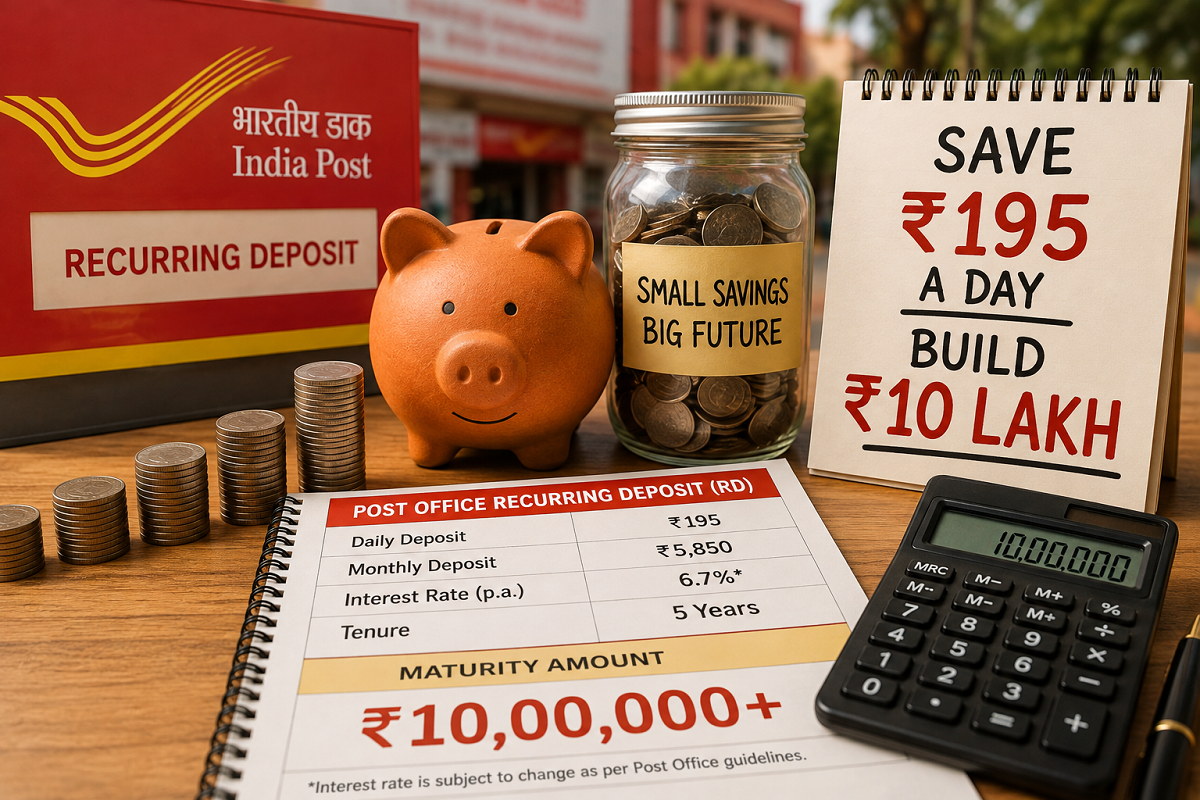
Post Office RD Scheme: Building a large savings corpus does not always require a big lump-sum investment. A disciplined monthly saving habit can also help create a sizeable fund over time. One such option is the Post Office Recurring Deposit, or RD, which allows investors to deposit a fixed amount every month.
If someone manages to save about ₹195 a day, that works out to roughly ₹5,860 a month. By continuing this amount regularly in a Post Office RD and extending the investment beyond the initial five-year term, the total corpus could move close to ₹10 lakh, depending on the applicable interest rate and scheme rules.
Here is how the calculation works and what investors should know before opening a Post Office RD account.
What Is a Post Office Recurring Deposit?
The Post Office RD is a small-savings scheme designed for people who want to invest regularly instead of depositing a large amount at one time.
Under the scheme, a fixed sum is deposited every month for the prescribed tenure. The account earns interest according to the rate notified for the scheme.
The basic idea may look similar to a monthly SIP because both encourage regular investing, but the two are very different products. A mutual fund SIP is market-linked, whereas the Post Office RD is a government-backed small-savings product with a predetermined interest framework.
For investors who prioritise capital stability and disciplined saving, an RD can be easier to understand than market-linked products.
How Much Does ₹195 a Day Become in a Month?
Saving ₹195 every day may appear manageable compared with making a large investment at once.
On a monthly basis, this comes to approximately:
₹195 × 30 days = about ₹5,850
The calculation used in the source assumes a monthly deposit of around ₹5,860.
If this amount is deposited consistently for five years, the total principal contribution would be approximately:
₹5,860 × 60 months = ₹3,51,600
Interest earned over the period would then be added to this contribution.
How Much Could You Get After 5 Years?
Based on the illustration provided, a monthly investment of approximately ₹5,860 for five years would result in a total contribution of ₹3,51,600.
At the stated annual interest rate of 6.7%, the estimated maturity value has been shown at around ₹4,18,201.
This means the remaining amount would come from interest earned during the five-year period.
However, investors should remember that the exact maturity amount depends on the interest calculation method, deposit dates and the rate applicable under Post Office rules.
Can the RD Continue Beyond 5 Years?
The normal Post Office RD tenure is five years, but the account can be continued or extended subject to the applicable scheme provisions.
If the investor continues the saving discipline for another five years, the total contribution over 10 years at ₹5,860 a month would be:
₹5,860 × 120 months = ₹7,03,200
According to the example, total interest over the extended period could approach ₹2.98 lakh, taking the overall fund to around ₹10,01,203.
This is how a relatively small daily saving is projected to grow into a corpus of roughly ₹10 lakh.
₹10 Lakh RD Calculation at a Glance
| Particular | Approximate Amount |
|---|---|
| Daily saving | ₹195 |
| Monthly deposit | ₹5,860 |
| Deposit over 5 years | ₹3,51,600 |
| Estimated value after 5 years | ₹4,18,201 |
| Total deposit over 10 years | ₹7,03,200 |
| Estimated interest over 10 years | Around ₹2.98 lakh |
| Estimated final corpus | Around ₹10,01,203 |
These figures are illustrative and should not be treated as a guaranteed maturity value.
What Interest Rate Does Post Office RD Offer?
The calculation above uses an annual interest rate of 6.7%.
Interest rates on government small-savings schemes can be reviewed and revised periodically. Therefore, anyone planning to open a new RD account should check the current notified rate before investing.
The maturity amount can change if the applicable interest rate differs from the one used in the illustration.
What Is the Minimum Amount Needed to Start?
A Post Office RD can be opened with a relatively small monthly contribution.
The minimum deposit amount is generally ₹100, with further deposits allowed in prescribed multiples under the scheme rules.
This makes the product accessible to people who want to start small and gradually increase their savings discipline.
Who Can Open a Post Office RD Account?
Individuals can open a Post Office RD account in their own name. Joint account facilities are also available in permitted cases.
Accounts for minors may also be allowed under the applicable small-savings rules, either through a guardian or under specified conditions.
The key requirement for any investor is to choose a monthly contribution that can realistically be maintained over the full investment period.
Monthly Deposits Should Be Made on Time
Regularity is important in an RD.
Unlike a one-time fixed deposit, a recurring deposit requires the investor to keep contributing every month. Missing scheduled deposits can attract default charges or penalties under the scheme rules.
Repeated missed payments may also affect the account's status.
Before committing ₹5,860 a month, an investor should first confirm that this amount can be comfortably set aside after meeting household expenses, insurance premiums, loan payments and emergency-fund needs.
Why Daily Saving Can Be a Useful Mental Strategy
The Post Office does not require you to deposit ₹195 every day. The actual RD contribution is made monthly.
However, thinking of the monthly amount as a daily saving target can make the goal easier to manage.
Instead of asking whether you can spare nearly ₹6,000 at the end of every month, you can think of it as putting aside around ₹195 each day.
This approach can make disciplined saving psychologically easier for some households.
Compounding Works Best With Time and Discipline
The main advantage of a long saving period is that interest has more time to accumulate.
In the first few years, the difference between the amount invested and the value of the account may not look very large. But as the investment continues, earlier interest earnings also contribute to the growth of the corpus.
This is why staying invested for 10 years can produce a much larger final amount than stopping after five years.
However, compounding does not guarantee that a target will be achieved. The final amount always depends on the interest rate, contribution pattern and applicable scheme rules.
Is Post Office RD Completely Risk-Free?
Post Office small-savings schemes are generally regarded as relatively secure because they are backed by the Government of India.
That does not mean investors should ignore other forms of risk.
For example, inflation can reduce the purchasing power of the money accumulated over several years. A corpus of ₹10 lakh a decade from now may not buy the same amount of goods and services that ₹10 lakh can buy today.
Investors should therefore evaluate the RD not only on safety but also on whether the expected return is suitable for their long-term financial goal.
What Should You Check Before Investing?
Before opening an RD, confirm the current interest rate and understand the maturity, extension and premature-closure provisions.
Also check what happens if a monthly installment is missed and whether loans or withdrawals are available under the prevailing rules.
Most importantly, do not choose a monthly deposit only because an illustration shows a large maturity amount. Your contribution should fit comfortably within your regular budget.
Can ₹195 a Day Really Become ₹10 Lakh?
Based on the assumptions used in the example, saving around ₹195 a day—or roughly ₹5,860 a month—and maintaining that discipline for about 10 years could build a corpus close to ₹10 lakh.
But the figure is an estimate rather than a guaranteed outcome.
The actual maturity value will depend on the interest rate in force, how the account is extended and whether every monthly installment is deposited on time.
For investors looking for a simple and relatively stable way to build savings gradually, the Post Office RD can be worth considering. The bigger lesson is that consistency often matters more than starting with a large amount.
Disclaimer: This article is for general informational purposes only. Interest rates, account rules, extension provisions and maturity values may change. Investors should verify the latest Post Office RD terms before opening or extending an account.