
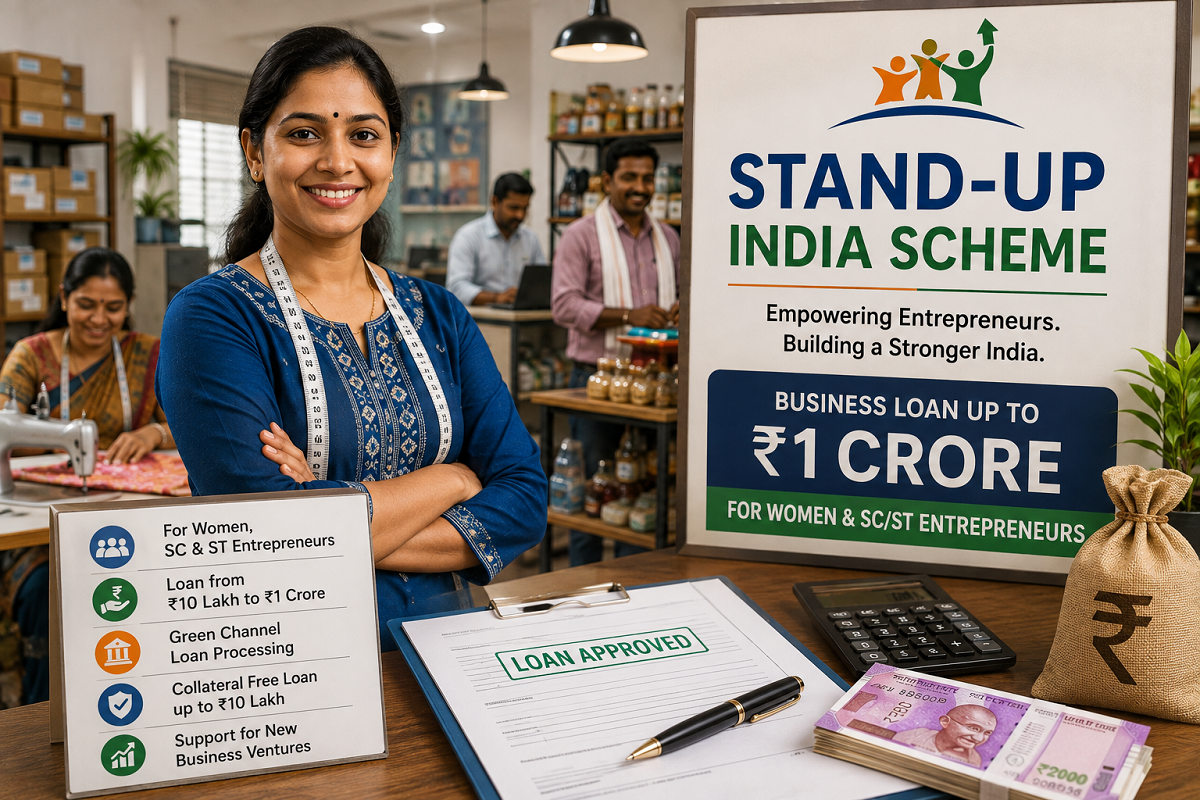
Stand-Up India Scheme: Aspiring entrepreneurs from eligible categories can access bank financing of up to ₹1 crore to start a new business under the Stand-Up India initiative. The scheme is aimed at encouraging entrepreneurship among women and members of the Scheduled Caste (SC) and Scheduled Tribe (ST) communities by improving access to institutional credit.
Eligible applicants can seek loans ranging from ₹10 lakh to ₹1 crore for setting up a new enterprise in sectors such as manufacturing, services or trading, subject to the applicable bank rules and project assessment.
The financing is generally structured as a composite loan, which means it can include both a term loan and working capital support. However, this is not free money or a grant. The loan must be repaid with interest according to the terms approved by the lending bank.
Here is a detailed look at who can apply, how much funding may be available and what borrowers should check before submitting an application.
What Is the Stand-Up India Scheme?
The Stand-Up India scheme was launched to support entrepreneurship among women and SC/ST communities by helping eligible first-time entrepreneurs establish greenfield enterprises.
A greenfield enterprise broadly refers to a new business venture rather than the expansion of an already existing enterprise.
The scheme is designed for people who may have a viable business idea but need access to formal bank credit to fund machinery, infrastructure, inventory, working capital or other eligible business requirements.
Applicants still need to demonstrate that their business proposal is commercially viable and that they meet the lender's credit assessment standards.
How Much Loan Can You Get?
Under the scheme, eligible applicants can seek a composite bank loan of between ₹10 lakh and ₹1 crore.
The financing may consist of:
- a term loan for long-term business requirements, and
- working capital for day-to-day operational expenses.
The exact loan amount sanctioned depends on the size of the project, eligible costs, repayment capacity and the bank's assessment of the proposal.
Applicants should not assume that meeting the basic eligibility criteria automatically means they will receive the maximum ₹1 crore.
What Is the Repayment Period?
The repayment period can extend up to seven years, subject to the terms approved by the lender.
A moratorium of up to around 18 months may also be available in eligible cases, depending on the bank and the project's requirements.
A moratorium generally gives the business some time before regular principal repayments begin, but borrowers should carefully check whether interest continues to accrue during this period.
The final repayment structure will depend on the loan agreement.
Who Is Eligible for a Stand-Up India Loan?
Applicants must satisfy the scheme's eligibility requirements as well as the lending bank's credit conditions.
Broadly, the applicant should meet the following conditions:
- The entrepreneur should be at least 18 years old.
- The applicant should be a woman entrepreneur or belong to the SC/ST category.
- The proposed venture should be a new or greenfield enterprise.
- In the case of a company, partnership or other eligible non-individual business structure, at least 51% ownership and controlling stake should generally be held by an eligible woman or SC/ST entrepreneur.
- The borrower should not be in default with a bank or financial institution.
- The project must satisfy the bank's commercial, documentation and repayment assessment.
Banks may ask for additional information depending on the business structure and loan size.
What Type of Business Can Be Started?
The scheme can support eligible new ventures in several sectors.
These broadly include manufacturing, services and trading activities.
For example, an eligible entrepreneur may consider setting up a manufacturing unit, retail outlet, service centre, trading business or other qualifying enterprise.
However, whether a specific project qualifies for financing depends on the applicable scheme rules and the lending bank's appraisal.
A technically eligible business can still be rejected if the project appears financially unviable or repayment capacity is weak.
Why a Strong Business Plan Matters
One of the most important parts of a business-loan application is the project report.
A good business plan should explain what the business will sell, who the customers are, how much capital is required and how the borrower expects to repay the loan.
It may also include estimated sales, expenses, cash flows, break-even projections and working-capital requirements.
Banks generally evaluate the viability of the proposal before sanctioning the loan.
An unrealistic business plan with overly optimistic revenue estimates can weaken the application, even if the borrower is otherwise eligible.
How to Apply for Stand-Up India
Eligible applicants can begin the process through the Stand-Up Mitra portal or by approaching a participating bank branch.
The portal can help applicants understand the scheme, assess the type of support required and connect with relevant banking channels.
Applicants may also directly visit a nearby bank branch and ask about Stand-Up India financing.
The bank will then assess eligibility, documentation, business viability and repayment capacity before making a lending decision.
What Documents May Be Required?
The exact list can vary, but applicants may generally be asked for documents such as:
- identity proof,
- address proof,
- category-related documents where applicable,
- business constitution documents,
- bank account details,
- project report or business plan,
- estimated project cost,
- ownership or partnership details, and
- other financial or compliance documents requested by the bank.
Applicants should submit accurate information because inconsistencies can delay processing.
Is Stand-Up India a Subsidy?
No. This is one of the most important points to understand.
The scheme provides access to a bank loan, not a free grant.
The borrower must repay the sanctioned amount along with interest and any applicable charges.
The scheme may make it easier for eligible entrepreneurs to access institutional finance, but repayment obligations remain in place.
Therefore, borrowers should assess whether the proposed business can generate sufficient cash flow to service the loan.
What About Margin Money and Security?
Margin requirements, collateral, guarantees and other credit conditions can vary depending on the loan, project and lender.
Applicants should ask the bank for a clear explanation of:
- required margin contribution,
- interest rate,
- processing charges,
- security or collateral requirements,
- guarantee-related provisions,
- repayment schedule, and
- moratorium terms.
These details can significantly affect the actual cost of borrowing.
Stand-Up India Loan at a Glance
| Feature | Details |
|---|---|
| Loan amount | ₹10 lakh to ₹1 crore |
| Target beneficiaries | Women and SC/ST entrepreneurs |
| Business type | New or greenfield enterprise |
| Eligible sectors | Manufacturing, services, trading and other permitted activities |
| Loan structure | Composite loan |
| Maximum repayment period | Up to 7 years |
| Possible moratorium | Up to 18 months, subject to lender terms |
| Ownership condition | At least 51% ownership/control by eligible applicant in qualifying non-individual entities |
| Final approval | Subject to bank appraisal |
What Should You Check Before Taking the Loan?
Before accepting the sanction, calculate the likely monthly repayment and compare it with the expected cash flow of the business.
Also read the loan agreement carefully instead of focusing only on the sanctioned amount.
A larger loan is not always better. Borrowing more than the business can comfortably repay can create financial stress.
Applicants should also keep enough working capital for the initial months because new businesses often take time to achieve stable revenue.
Who Can Benefit Most From the Scheme?
The scheme can be useful for eligible entrepreneurs who have a clear business concept, basic industry understanding and a practical financial plan but require bank financing to begin operations.
For women and SC/ST entrepreneurs, the ₹10 lakh to ₹1 crore financing range can help fund relatively substantial projects that may not be possible through personal savings alone.
However, the scheme should be viewed as an opportunity to access credit, not as guaranteed approval.
The bank will make the final decision based on documentation, business viability, credit profile and repayment capacity.
Bottom Line
Stand-Up India can provide eligible women and SC/ST entrepreneurs with a formal route to obtain business financing for a new venture.
The scheme offers composite loans ranging from ₹10 lakh to ₹1 crore for qualifying enterprises, with repayment periods that may extend up to seven years.
Before applying, entrepreneurs should prepare a realistic business plan, organise all necessary documents and understand the interest rate, margin, repayment and security conditions.
A strong business idea combined with disciplined financial planning can improve the chances of building a sustainable enterprise and repaying the loan successfully.
Disclaimer: Loan eligibility, interest rates, repayment terms, collateral requirements and scheme conditions may change. Applicants should verify the latest rules through official Stand-Up India channels or the concerned bank before applying.