
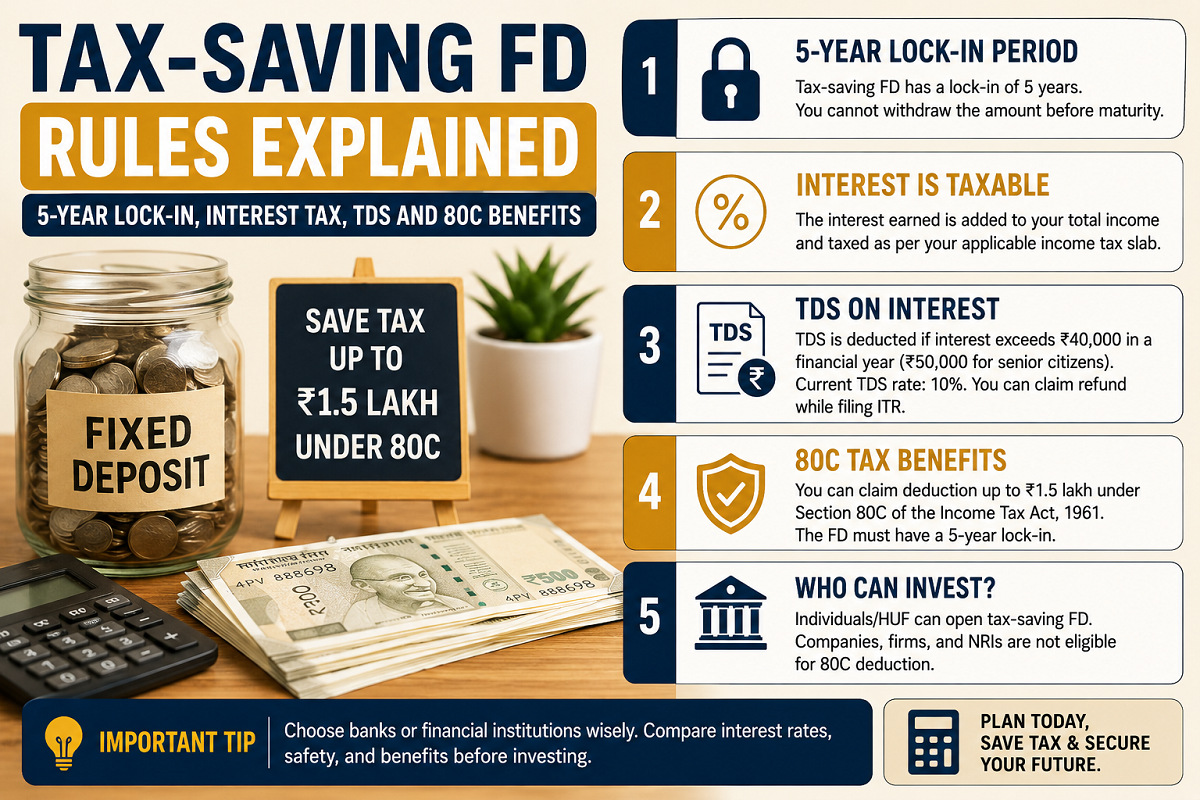
Tax-Saving FD Explained: A five-year tax-saving fixed deposit is a popular option for investors who want predictable returns along with a tax deduction under Section 80C, where applicable. However, one point often causes confusion: if the bank pays the accumulated interest only at maturity, is the entire interest taxed after five years, or does tax apply every year?
The key distinction is between the tax benefit on the amount invested and the tax treatment of the interest earned. The principal invested in an eligible tax-saving FD may qualify for deduction under Section 80C under the old tax regime, subject to the overall limit. But the interest earned on that deposit is generally taxable.
This means a tax-saving FD is not completely tax-free.
When Is Interest on a Tax-Saving FD Considered Income?
A tax-saving FD typically has a five-year lock-in period. Depending on the bank and deposit option, interest may be credited periodically or accumulated and paid at maturity.
For tax purposes, however, the timing of the actual payment is not always the only factor that matters.
If interest accrues on the deposit during a financial year, it may need to be considered as income for that year even if the money is physically received later.
This is why investors should not automatically assume that all five years of interest will become taxable only when the FD matures.
Does Tax Apply Every Year?
In general, interest earned on a bank fixed deposit is taxable and is usually reported under Income from Other Sources.
If interest accrues during a financial year, the relevant amount may need to be included in the income-tax return for that year, depending on the applicable method of accounting and tax treatment.
For example, suppose an investor places ₹1 lakh in a five-year tax-saving FD and chooses a cumulative option where the bank pays principal and accumulated interest only at the end.
Even in such a case, the annual interest accumulation should not automatically be ignored for four years and treated as taxable income only in the fifth year.
Investors should maintain annual interest records and reconcile them with bank certificates and tax statements.
Will Tax Paid Earlier Be Refunded at Maturity?
No. If interest accrued in an earlier financial year and was correctly reported and taxed in that year, the tax paid does not simply come back when the FD matures.
The important principle is to avoid taxing the same income twice.
If interest has already been offered to tax in earlier years, it should not again create a fresh tax liability merely because the accumulated amount is finally received at maturity.
This is why keeping year-wise records is important for cumulative fixed deposits.
What If the Bank Deducts TDS at Maturity?
Banks may deduct tax at source on interest income when applicable thresholds and rules are triggered.
If TDS is deducted at maturity on accumulated interest, the taxpayer should compare the deduction with the interest already reported in earlier years.
The TDS reflected in Form 26AS, AIS or other applicable tax records can generally be claimed as credit while filing the return.
If the TDS deducted is higher than the final tax liability, the excess may be claimed as a refund through the income-tax return, subject to normal processing and verification.
TDS is not a separate tax over and above your final tax liability. It is essentially tax collected in advance.
Where Is the Real Tax Benefit in a Tax-Saving FD?
The tax advantage is linked primarily to the eligible investment amount, not to the interest earned.
Under the old tax regime, eligible investments in a five-year tax-saving FD can form part of the Section 80C deduction limit, which is generally capped at ₹1.5 lakh in aggregate along with other qualifying investments and payments.
The interest generated by the FD, however, remains taxable.
So, in simple terms:
| Component | Tax Treatment |
|---|---|
| Eligible amount invested | May qualify under Section 80C under the old tax regime |
| Interest earned | Taxable |
| Lock-in period | 5 years |
| Premature withdrawal | Generally not permitted during lock-in |
| Interest payout | May be periodic or cumulative depending on deposit option |
Where Should FD Interest Be Shown in the ITR?
Interest earned from a tax-saving fixed deposit is generally reported under Income from Other Sources.
The interest gets added to the taxpayer's total income and is taxed according to the applicable income-tax slab and regime.
This also means that merely because the bank has deducted TDS, the taxpayer cannot ignore the interest in the return.
Both the interest income and TDS credit should be reported correctly.
When Can TDS Apply on FD Interest?
TDS on bank-deposit interest depends on the threshold and rules applicable in the relevant financial year.
Separate thresholds may apply to senior citizens.
Since these limits can change, investors should check the rules for the financial year in which the interest is earned rather than relying on an old threshold.
If TDS has been deducted, the corresponding interest income still needs to be included in the return. The TDS amount can then be adjusted against the final tax liability.
Main Advantages of a Tax-Saving FD
A tax-saving FD can appeal to conservative investors because returns are generally known in advance.
One major benefit is the potential Section 80C deduction under the old tax regime. Another is the relatively predictable return compared with market-linked products.
The five-year lock-in can also help investors maintain long-term savings discipline.
For people who prefer bank deposits over market-linked investments, a tax-saving FD can therefore provide simplicity and certainty.
What Are the Drawbacks?
The biggest limitation is that the interest is taxable.
The five-year lock-in also reduces liquidity because premature withdrawal is generally not available.
Another factor is inflation. Even though the interest rate is fixed, the real return after tax and inflation may be significantly lower.
The attractiveness of Section 80C also depends on the tax regime chosen by the taxpayer. Someone using a tax regime that does not allow the relevant deduction may not receive the same benefit.
Simple Example: ₹1 Lakh Invested for 5 Years
Suppose an investor deposits ₹1 lakh in a cumulative five-year tax-saving FD.
The bank compounds the interest every year but pays everything together at maturity.
It would be incorrect to automatically assume that the entire accumulated interest becomes taxable only in the fifth year.
Instead, the investor should track the interest accruing each financial year and ensure the tax return reflects the applicable amount.
If, in the maturity year, the bank deducts TDS on a larger accumulated interest figure, the taxpayer should reconcile it with previous-year declarations to avoid double taxation.
Any excess TDS can potentially be claimed back through the ITR.
Important Checks for Tax-Saving FD Investors
Investors should maintain annual interest certificates or statements and compare them with Form 26AS and AIS.
They should also remember that the Section 80C deduction and the taxation of FD interest are two separate matters.
The investment may give a deduction, but the return generated from that investment is not automatically tax-exempt.
Before filing the return, investors should also verify the TDS threshold, applicable tax regime and any changes in income-tax rules for that financial year.
Bottom Line
A tax-saving FD combines a five-year lock-in with the possibility of a Section 80C deduction under the old tax regime, but the interest it earns is taxable.
For cumulative deposits, investors should not assume that taxation begins only when the FD matures. Interest accruing during each financial year may need to be considered in that year's tax return.
The safest approach is to keep year-wise interest records, reconcile TDS with Form 26AS and AIS, and make sure the same interest is not taxed twice.
Disclaimer: This article is for general information only and does not constitute tax advice. Income-tax rules, TDS thresholds and deduction provisions can change. Taxpayers should verify the rules applicable to the relevant financial year or consult a qualified tax professional before filing their return.