Business
8th Pay Commission Pension Update: ₹45,000 Minimum Pension and OPS Restoration Demanded by Unions
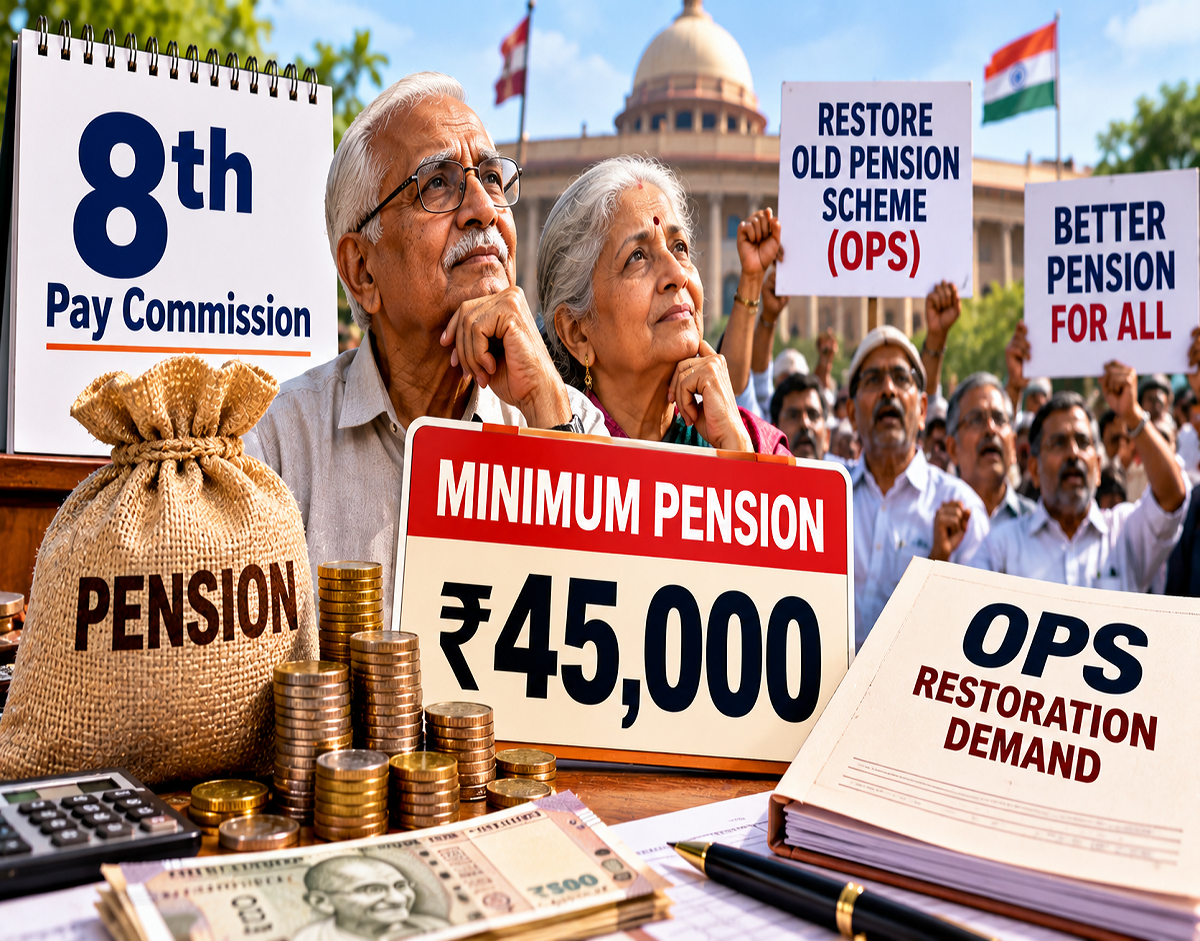
Discussions around the 8th Central Pay Commission are increasingly focusing on pensions, with several employee and pensioner organisations seeking major changes to the retirement benefits available to Central Government employees.
Among the demands being raised are restoration of the Old Pension Scheme (OPS), a guaranteed pension linked to the employee's last basic pay, and a substantial increase in minimum pension. One pensioners' organisation has reportedly sought a minimum pension of ₹45,000 per month, along with a higher pension formula.
However, pensioners and employees should note an important distinction: these figures are demands submitted by organisations to the 8th Pay Commission. They have not been approved by the Commission or the Central Government.
The 8th Central Pay Commission was formally constituted on November 3, 2025, under the chairmanship of Justice Ranjana Prakash Desai. It has been given 18 months to submit its report.
Why Has Pension Become a Major 8th Pay Commission Issue?
Salary revision, allowances, fitment and pension benefits are among the subjects drawing attention during the 8th Pay Commission process.
Employee and pensioner organisations have been submitting their representations and making their case before the Commission.
A particularly important debate concerns the pension framework for employees covered by different retirement systems.
Several organisations have argued in their representations that employees should receive greater certainty about their post-retirement income.
This has brought the debate over the Old Pension Scheme, National Pension System and Unified Pension Scheme into focus during discussions surrounding the 8th CPC.
Demand 1: Restore the Old Pension Scheme
One of the prominent demands reported in the submissions is restoration of the Old Pension Scheme.
The Ministerial Staff Association representing Survey of India employees has reportedly sought complete restoration of OPS.
According to the demand cited in the source, employees should receive a guaranteed pension equivalent to at least 50% of the last basic pay drawn at the time of retirement.
This is an employee-organisation proposal and should not be confused with an approved government decision.
Whether the 8th Pay Commission will recommend such a change—and whether the government would subsequently accept it—remains to be seen.
Demand 2: Bring NPS and UPS Employees Under a Defined-Benefit System
The Federation of National Postal Organisations (FNPO) has also raised pension-related concerns.
According to the source report, the organisation has argued that the existing NPS framework and the Unified Pension Scheme have not fully addressed the concerns of employees seeking greater certainty in retirement income.
It has consequently sought a return to a defined-benefit pension arrangement for employees currently covered by NPS and UPS.
Again, this represents the organisation's position before the Commission rather than a change already announced by the government.
Demand 3: Guaranteed Minimum Pension
The Railway Senior Citizens Welfare Society has also raised pension-security issues.
Its representations have focused on improving financial security for retired employees and strengthening pension-related protection.
RSCWS has separately argued for restoration of a defined-benefit pension system and stronger safeguards for pensioners.
The organisation has also raised issues relating to healthcare and other post-retirement benefits.
These submissions form part of the broader consultation around the 8th CPC and do not by themselves change the pension payable to existing retirees.
Demand 4: ₹45,000 Minimum Monthly Pension
One of the most eye-catching figures in the current debate is a demand for a minimum pension of ₹45,000 per month.
According to the source report, Bharat Pensioners Samaj (BPS) has proposed that the minimum pension be increased to ₹45,000 per month.
The organisation has also reportedly sought a pension equivalent to 67% of last pay and family pension equivalent to 50% of last pay.
These figures are proposals from the pensioners' organisation.
There is currently no basis to treat ₹45,000 as the officially approved minimum pension under the 8th Pay Commission.
Major Pension Demands at a Glance
| Organisation | Demand Reported |
|---|---|
| Ministerial Staff Association, Survey of India | Restoration of OPS and at least 50% of last basic pay as guaranteed pension |
| Federation of National Postal Organisations | Bring employees covered by NPS/UPS back under a defined-benefit pension framework |
| Railway Senior Citizens Welfare Society | Stronger guaranteed pension and retirement security |
| Bharat Pensioners Samaj | ₹45,000 minimum pension, 67% of last pay as pension and 50% family pension |
These are stakeholder demands and should not be read as recommendations already accepted by the 8th CPC.
8th Pay Commission Consultation Process Is Underway
The 8th Central Pay Commission has been collecting views from employees, pensioners, associations, unions and other stakeholders.
It earlier invited structured memoranda and representations through its official system.
The Commission has also been conducting interactions and visits to different parts of the country to hear stakeholder concerns.
Recent and scheduled visits include consultations in cities and Union Territories across India.
The Commission's official schedule includes a visit to Bengaluru on October 7 and 8, 2026.
Such meetings allow employee associations and other stakeholders to present their concerns on matters including pay, allowances, pensions and service conditions.
When Could the 8th CPC Report Arrive?
The Commission was formally constituted on November 3, 2025 and has been given 18 months to submit its report.
This timeline points broadly to 2027 for completion of the report, subject to the Commission's actual working schedule and any subsequent government decisions.
It is important to understand that submission of the Commission's report will not automatically mean that every demand made by unions or pensioner organisations has been accepted.
The Commission first evaluates the issues before it and makes recommendations.
The Central Government then considers those recommendations and decides what will ultimately be accepted and implemented.
Will OPS Definitely Return Under the 8th Pay Commission?
There is currently no basis for saying that OPS will definitely be restored because employee organisations have demanded it.
A demand submitted to the Commission is the beginning of a consultation process, not the final outcome.
The Commission can consider stakeholder representations while preparing its recommendations, but the final policy decision rests with the government after the report is submitted and examined.
Therefore, headlines claiming that OPS has already been restored under the 8th Pay Commission would be premature.
Is ₹45,000 Minimum Pension Confirmed?
No.
The ₹45,000 figure being discussed is a demand, according to the source report.
It should not be described as a new minimum pension announced by the government.
Similarly, proposals for pension at 50% or 67% of last pay should be clearly attributed to the organisations making those demands.
Until the Commission submits its recommendations and the government takes a decision, these figures remain proposals rather than approved benefits.
What About the Fitment Factor?
The fitment factor is another widely discussed subject surrounding the 8th Pay Commission.
Various figures have appeared in media reports, union representations and unofficial calculations.
However, speculative fitment factors should not be used to calculate a supposedly confirmed future salary or pension unless the Commission or government formally announces the applicable formula.
The eventual revision of pay and pension will depend on the recommendations of the 8th CPC and the government's decisions on those recommendations.
What Should Pensioners Watch Next?
For pensioners and Central Government employees, the most meaningful developments will come from official Commission documents and, eventually, the final recommendations.
Stakeholder meetings and memoranda are useful indicators of what employees and pensioners are seeking, but they should not be mistaken for policy decisions.
The Commission's upcoming consultations, including the Bengaluru meetings on October 7–8, will remain worth watching as organisations continue to raise pay and pension issues.
Bottom Line
The 8th Pay Commission has intensified discussions around the future of Central Government salaries and pensions.
Employee and pensioner organisations are seeking substantial reforms, including restoration of OPS, guaranteed retirement income, a ₹45,000 minimum monthly pension and pension formulas linked more closely to last pay.
For now, however, these remain demands placed before the Commission.
Neither a ₹45,000 minimum pension nor universal OPS restoration has been confirmed merely because these proposals have been submitted.
The next major stage will be the Commission's recommendations, followed by the Central Government's consideration and decision on what will actually be implemented.