
Business
Post Office Scheme: Save ₹200 Daily and Build Around ₹4.28 Lakh—Check Interest Rate and Calculation
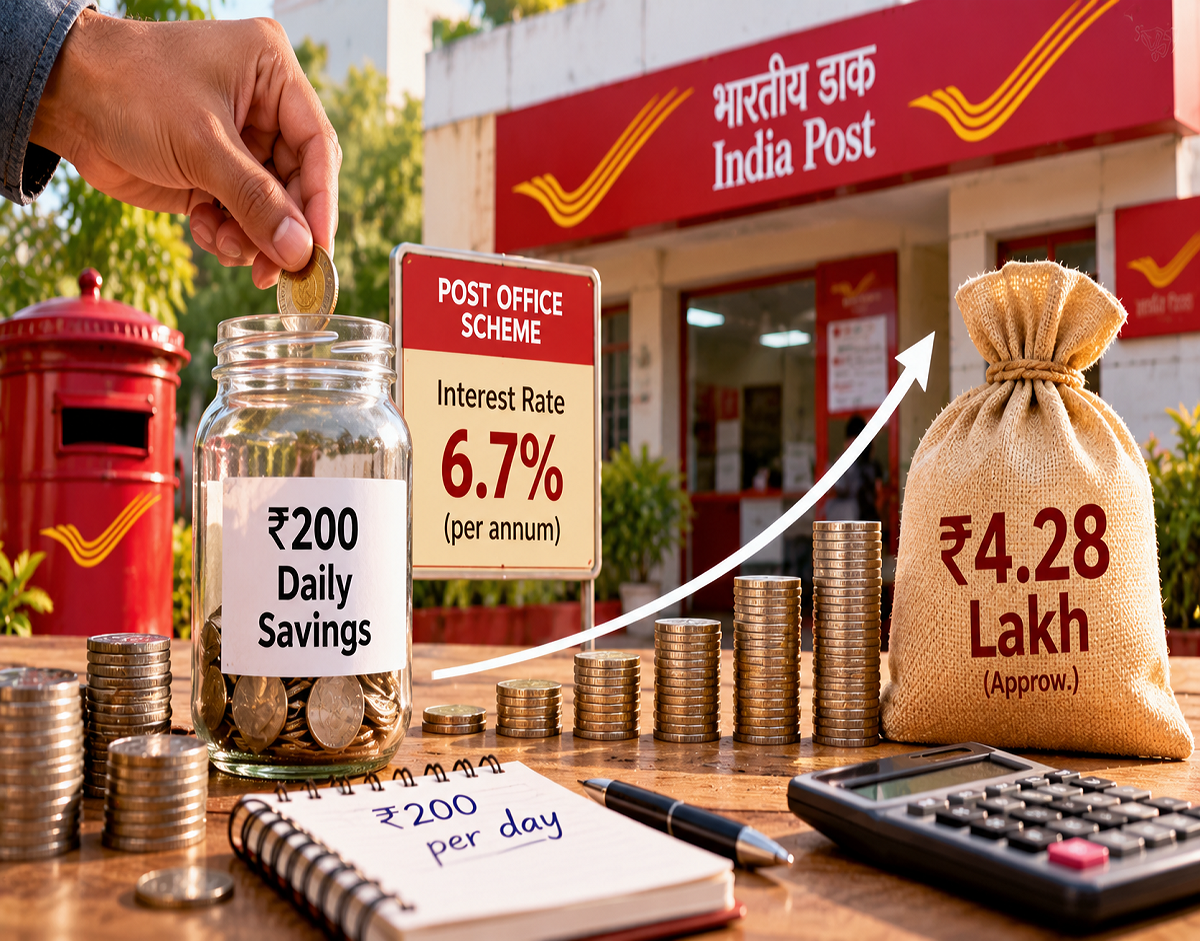
Saving a small amount regularly can gradually create a sizeable corpus, particularly for people who prefer government-backed small savings products instead of market-linked investments. One such Post Office savings option is attracting attention because an investment equivalent to ₹200 a day can potentially grow to around ₹4.28 lakh, based on the calculation cited in the source report.
The scheme offers an interest rate of 6.7% per annum, according to the supplied information.
The important point, however, is that investors do not literally have to deposit ₹200 at the Post Office every day. The daily figure is simply an easy way to understand the savings requirement.
Saving ₹200 each day works out to approximately ₹6,000 a month, depending on how the calculation is structured. Regularly investing this amount over the scheme's tenure can create a corpus consisting of the investor's deposits plus the interest earned.
Before investing, it is important to understand the actual deposit rules, tenure, interest calculation and maturity conditions of the scheme.
How Does the ₹200-a-Day Calculation Work?
The idea behind the calculation is straightforward.
If you put aside ₹200 every day, your approximate monthly savings would be:
₹200 × 30 days = ₹6,000 per month
Over one year, a ₹6,000 monthly contribution would amount to:
₹6,000 × 12 months = ₹72,000
If the investment continues regularly for several years, the total amount deposited becomes substantial even before interest is added.
The source report indicates that under the Post Office scheme being discussed, this regular saving strategy can build a maturity amount of around ₹4.28 lakh, based on the applicable assumptions.
The precise maturity value depends on the deposit schedule, tenure and interest calculation applicable to the account.
Interest Rate of 6.7%
According to the source information, the scheme currently carries an annual interest rate of 6.7%.
Interest plays an important role in increasing the final maturity amount beyond the money deposited by the investor.
However, investors should remember that interest rates on government small savings schemes can be reviewed periodically. The rate applicable to a particular account and how it is treated during the investment tenure depends on the rules of that specific scheme.
Therefore, a calculation based on 6.7% should be understood in the context of the interest rate and rules used for that illustration.
Why Small Daily Savings Can Become a Large Corpus
The biggest lesson from the ₹200 example is not necessarily the daily amount itself. It is the effect of regular saving over several years.
An investor may find it difficult to arrange several lakh rupees at once, but putting aside a smaller amount every month can be easier to manage.
For example, someone saving around ₹6,000 every month is contributing approximately ₹72,000 in a year.
As these deposits accumulate and earn interest, the overall corpus gradually increases.
This approach can be useful for people saving toward medium-term financial goals such as education expenses, a major purchase, an emergency fund or another planned requirement.
Is ₹4.28 Lakh Pure Profit?
No. This distinction is important.
If a calculation says that an investor can receive approximately ₹4.28 lakh at maturity, the entire ₹4.28 lakh should not be considered profit.
A large portion of that amount comes from the investor's own deposits.
The actual earnings are the difference between the total amount contributed and the maturity value, subject to the scheme's interest calculation and applicable rules.
For example, if someone deposits ₹6,000 every month for several years, those monthly contributions themselves make up a significant part of the final corpus.
The interest earned is added to those deposits.
Why Post Office Savings Schemes Attract Investors
Post Office savings products are popular among people who prioritise stability and predictable rules over potentially higher but market-linked returns.
Unlike shares or equity mutual funds, returns on traditional Post Office deposit products are not directly tied to daily stock-market movements.
This makes them attractive to conservative investors and people saving for specific financial goals.
Another advantage is accessibility. Post Offices have a wide network across India, including smaller towns and rural areas.
However, investors should still compare returns, liquidity, taxation and premature withdrawal conditions before choosing any savings product.
Regular Saving Matters More Than the Daily Figure
The phrase “save ₹200 every day” makes the investment appear simple, but financial discipline is the real requirement.
Instead of physically setting aside money every day, an investor could plan a monthly savings target of around ₹6,000.
This amount can be incorporated into the household budget alongside regular expenses.
Setting aside the investment amount soon after receiving a salary or other income can also reduce the temptation to spend the money elsewhere.
Check Premature Withdrawal Rules
Before opening any Post Office account, investors should understand what happens if they need the money before maturity.
Some savings schemes allow premature closure only after a specified period or under particular conditions. Penalties or a lower applicable return may also apply in certain circumstances.
This becomes important if the investor may require access to the money for an emergency.
A long-term deposit should therefore not replace an easily accessible emergency fund.
Interest Rates Should Be Checked Before Investing
Small savings interest rates can be reviewed by the government periodically.
Anyone considering this strategy should verify the rate applicable when opening the account instead of assuming that 6.7% will necessarily remain the relevant rate for every future investment period.
Investors should also check whether interest is compounded, when it is credited and how the maturity amount is calculated.
These details can make a noticeable difference to the final return.
Don't Invest Only Because of a Viral Maturity Figure
Headlines such as “save ₹200 and get ₹4.28 lakh” can make a savings scheme look unusually profitable.
But investors should examine the full calculation.
The ₹4.28 lakh figure includes the money deposited over the investment period plus the interest generated on those deposits. It is not ₹4.28 lakh earned simply from a ₹200 one-time investment.
The better way to evaluate the scheme is to ask three questions: How much will I deposit in total? How much interest will I earn? How long will my money remain invested?
A Simple Savings Habit Can Make a Difference
For someone who can comfortably save ₹200 a day, setting aside roughly ₹6,000 every month can create meaningful savings over time.
According to the calculation highlighted in the source, investing through the relevant Post Office scheme at an interest rate of 6.7% can potentially build a corpus of around ₹4.28 lakh, subject to the scheme's exact tenure and deposit rules.
Before investing, consumers should verify the current interest rate, maturity period, contribution limits, premature withdrawal conditions and tax treatment through an authorised Post Office channel.
The larger takeaway is simple: even a modest amount can grow into a useful corpus when saving becomes regular and continues for several years.