India's culinary heritage is enormous, but not every traditional dish has survived the shift towards modern lifestyles. While recipes such as biryani, dosa, rajma and butter chicken have become popular across regions, hundreds of lesser-known preparations have quietly disappeared from everyday kitchens.
The reasons are often simple. Some dishes require hours of preparation, while others depend on seasonal or locally grown ingredients that are now difficult to find. In many families, recipes were never written down. They were taught by watching parents and grandparents cook, so when younger generations stopped learning them, the knowledge gradually faded.
From old Madhya Pradesh preparations to forgotten dishes from Awadhi, Himachali, Bihari and Uttarakhand cuisines, India's culinary archives contain plenty of recipes that deserve another chance.
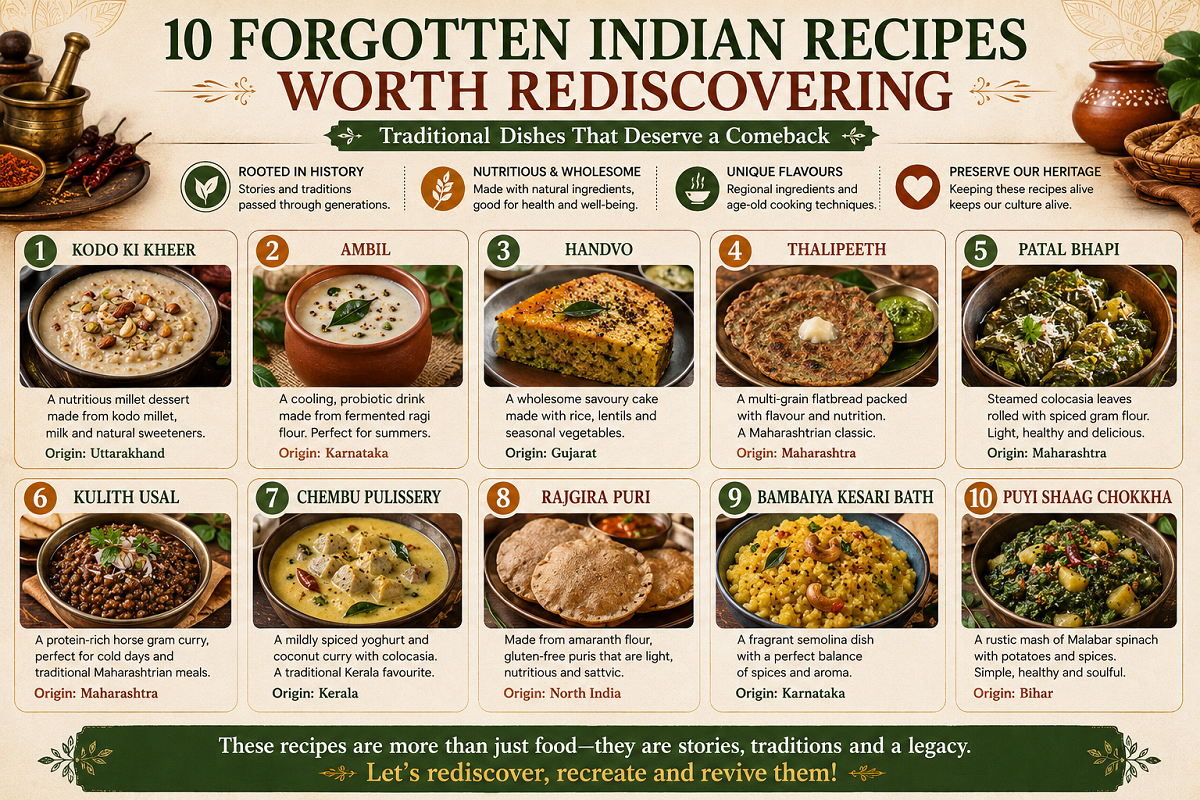
Here are 10 traditional Indian dishes worth rediscovering and bringing back to our kitchens.
1. Jwar Ka Khichda – A Millet-Based Traditional Meal
Long before millets became fashionable health foods, grains such as jowar formed an important part of everyday diets in many Indian communities.
Jwar ka khichda is one such traditional preparation associated with older regional food practices, including those documented in Madhya Pradesh.
Its decline illustrates an interesting change in Indian eating habits. As rice and wheat became increasingly dominant, numerous preparations made from traditional millets became less common.
Today, renewed interest in millets creates an opportunity to rediscover such recipes rather than treating these grains as a completely new food trend.
2. Kola Ki Kheer – A Nearly Forgotten Sweet Preparation
India has countless varieties of kheer, but only a handful are widely recognised today.
Kola ki kheer is among the lesser-known traditional preparations documented as disappearing from regular household cooking in parts of Madhya Pradesh.
Traditional sweets were frequently linked to locally available ingredients and seasonal cooking practices. As commercially produced desserts became easier to obtain, some labour-intensive household recipes slowly vanished.
Bringing such regional desserts back can help preserve the diversity hidden behind the broad category of "Indian sweets."
3. Gulgula – An Old-Fashioned Sweet Treat
Gulgula is another traditional preparation that deserves renewed attention.
Versions of these small sweet treats can still be found in different regions, although they are far less prominent than commercially popular desserts.
Traditional recipes generally use straightforward household ingredients and frying techniques, but proportions and preparation methods can differ considerably from one community to another.
Its story also demonstrates an important point: a dish doesn't have to disappear completely to become endangered. Sometimes it continues to exist in a few homes while gradually vanishing from mainstream food culture.
4. Mehri – Everyday Food That Became Unfamiliar
Some disappearing Indian recipes were never luxurious dishes intended for royal feasts.
They were simply everyday food.
Mehri, mentioned among older Madhya Pradesh preparations, represents precisely this category.
Such dishes are particularly vulnerable because families may not consider them important enough to document. Elaborate festival recipes might be carefully remembered, while simple everyday meals are taken for granted.
Ironically, these ordinary dishes can tell food historians the most about how previous generations actually ate.
5. Rasputka – A Name Many Younger Diners May Never Have Heard
Rasputka is another preparation associated with the disappearing culinary traditions documented in Madhya Pradesh.
For many people outside the region—and even some younger people within it—the name itself may be unfamiliar.
That demonstrates how quickly culinary memory can fade.
Once a dish stops appearing regularly at home, the next generation may know the name without knowing the method. One generation later, even the name can disappear.
Documenting such preparations is therefore important before the people who still know the original methods are no longer able to pass them on.
6. Paani Ki Roti – A Reminder of India's Diverse Bread Traditions
Mention Indian bread and most people immediately think of roti, naan, paratha or puri.
But India's traditional bread culture is considerably broader.
Paani ki roti is among the lesser-known regional preparations that has been discussed in the context of traditional foods becoming increasingly difficult to encounter.
Recipes like this remind us that "Indian bread" isn't a single culinary tradition.
Different communities developed techniques according to available grains, cooking equipment, climate and household requirements. Preserving these methods is just as important as preserving elaborate curries and sweets.
7. Mahni – A Himachali Recipe Worth Keeping Alive
The cuisine of Himachal Pradesh contains numerous dishes that remain relatively unfamiliar outside the region.
Mahni is one traditional preparation that has received attention through culinary revival and documentation efforts.
Himachali cuisine reflects geography, climate and the ingredients traditionally available in mountain communities. When such dishes disappear, we lose more than flavour—we also lose information about how people adapted their diets to their surroundings.
Regional food revival projects can help introduce these recipes to people who might otherwise never encounter them.
8. Chandrakala – Bihar's Traditional Sweet Heritage
Chandrakala is associated with Bihar's rich tradition of sweets and festive foods.
Its distinctive preparation makes it more elaborate than the everyday packaged sweets many consumers purchase today.
Recipes requiring careful shaping, stuffing and frying naturally become less convenient in households where people have limited time for cooking.
Yet festival dishes like Chandrakala carry cultural value precisely because of the effort involved in preparing them.
Rather than disappearing completely, such foods can survive when families continue making them occasionally for celebrations and teach younger members the process.
9. Sael Roti – A Traditional Uttarakhand Preparation
Uttarakhand's food culture has developed around its mountain environment, local grains and seasonal ingredients.
Sael roti is one of the regional preparations highlighted through efforts to rediscover lesser-known Indian foods.
Mountain cuisines are particularly important to document because migration can rapidly change household eating habits.
When younger people move to cities for education or employment, ingredients and traditional cooking equipment may no longer be readily available. Recipes that were once ordinary can consequently become special-occasion foods before disappearing further.
10. Mutanjan – An Old Awadhi Dish Making Its Way Back
Awadhi cuisine is famous for kebabs, biryanis and kormas, but its historical repertoire was far broader than the dishes commonly found on restaurant menus today.
Mutanjan is among the traditional preparations that culinary revival efforts have attempted to bring back into public awareness.
Historically, knowledge in royal and specialist kitchens was sometimes closely guarded and transmitted directly between cooks.
That made certain dishes vulnerable. If the technique wasn't recorded or passed to another cook, the authentic preparation could disappear.
The renewed interest in forgotten Awadhi cuisine demonstrates how chefs and culinary historians can play a meaningful role in reconstructing and preserving food traditions.
Why Did So Many Indian Recipes Disappear?
There isn't one single explanation.
Changes in lifestyle are a major factor. A dish that requires soaking ingredients overnight, hand-grinding spices and several hours of slow cooking may struggle to compete with meals that can be prepared in 20 minutes.
Ingredient availability is another problem.
Traditional dishes sometimes depend on a specific local grain, vegetable, fruit, fish or wild green. When agricultural practices change and farmers stop producing that ingredient, the recipe becomes difficult to reproduce.
Migration has accelerated the process as well.
Families moving from villages to large cities may lose access to ingredients and equipment that were readily available in their hometowns.
But perhaps the biggest vulnerability is oral transmission.
Many Indian household recipes were never measured or written down. Someone simply watched their mother or grandmother cook and gradually learned to reproduce the dish.
If nobody watches, the recipe can end with that generation.
Forgotten Recipes Are Starting to Return
Fortunately, India's disappearing food traditions are attracting renewed attention.
Chefs, food researchers, cultural organisations and home cooks are documenting old recipes and experimenting with ways to bring them back.
Traditional preparations such as mahni, chandrakala, sael roti and amba khatta, along with forgotten Awadhi dishes including mutanjan and lehsun ki kheer, have gained fresh visibility through culinary revival initiatives.
Social media has also created an unexpected archive. A grandmother demonstrating a regional recipe on video can potentially preserve a technique more effectively than a written ingredient list because viewers can see texture, consistency and cooking methods.
Why These Recipes Deserve a Comeback
Bringing forgotten food back isn't simply an exercise in nostalgia.
Traditional recipes can preserve knowledge about seasonal eating, regional agriculture, local ingredients, fermentation, preservation and low-waste cooking.
They also provide culinary identity.
India's food diversity becomes less interesting if every city eventually serves exactly the same limited collection of dishes.
Preserving local recipes keeps regional distinctions alive.
The Bottom Line
Recipes such as jwar ka khichda, kola ki kheer, gulgula, mehri, rasputka, paani ki roti, mahni, chandrakala, sael roti and mutanjan represent only a tiny fraction of India's disappearing culinary heritage.
Not every forgotten dish needs to become a restaurant bestseller. Some simply need to return to household kitchens occasionally.
The easiest preservation project may begin at home: ask parents or grandparents about a dish they remember from childhood, record how they make it and cook it together.
Every forgotten recipe prepared again is one less piece of India's culinary history at risk of disappearing.