Technology
AQI Check Online 2026: 5 Easy Ways to Check Air Pollution Levels Near You Using Your Phone
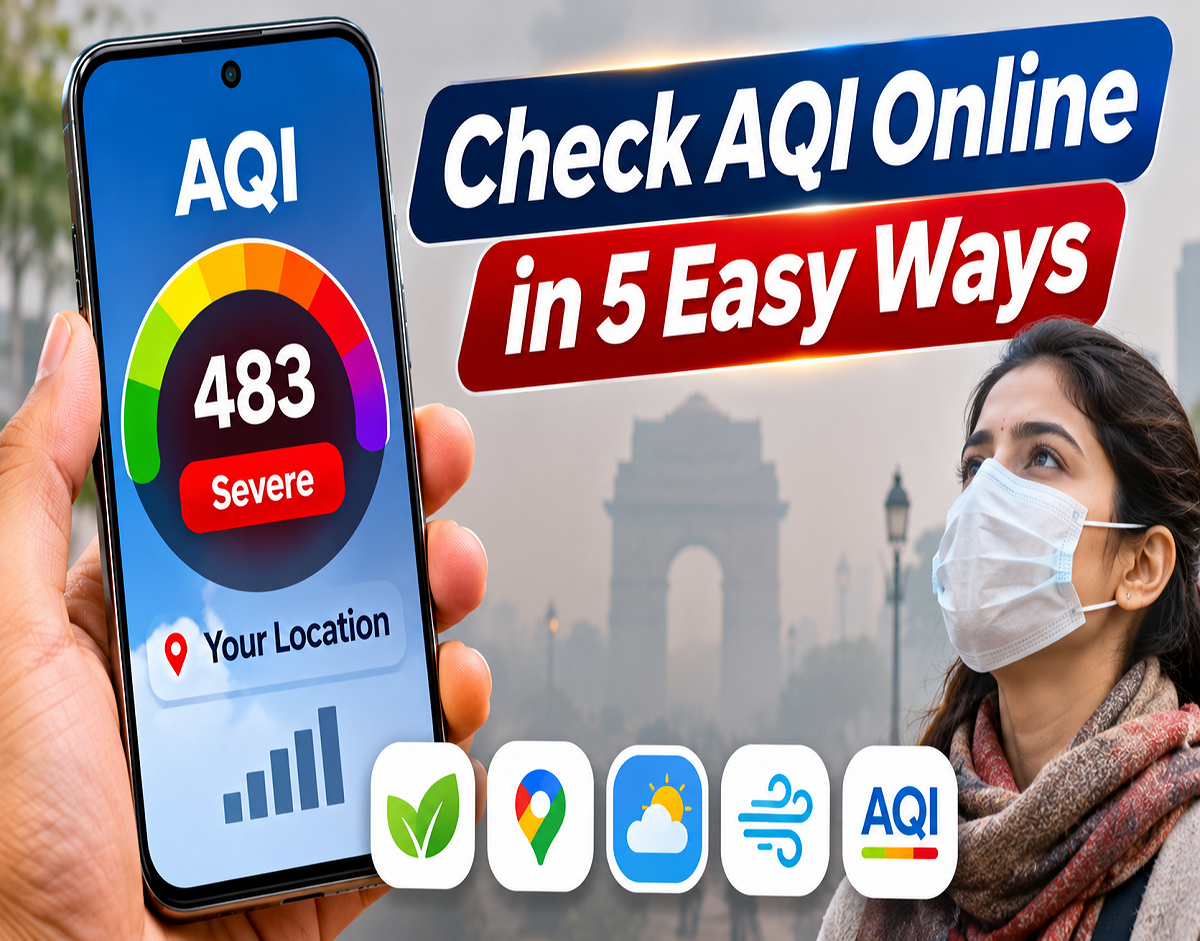
Air Quality Index Check 2026: Worried about rising air pollution in your city? You no longer need specialised equipment to find out whether the air around you is safe for outdoor activities. With an Android smartphone or iPhone, you can check the Air Quality Index (AQI) using government platforms, Google Maps, weather applications and online air pollution monitoring services.
Air pollution often becomes a major concern during the winter months, particularly in Delhi-NCR and other densely populated urban areas. Vehicle emissions, construction dust, industrial activity and weather conditions can contribute to poor air quality.
Pollution levels can also change throughout the day, making it useful to check the latest available AQI before going for a morning walk, exercising outdoors or planning activities for children.
Here are five convenient ways to monitor air quality directly from your smartphone.
1. Check Official AQI Readings Using the CPCB SAMEER App
The Central Pollution Control Board (CPCB) provides air quality information through its SAMEER mobile application.
The app allows users to view pollution readings from monitoring stations across participating Indian cities.
Depending on data availability, users can check the overall AQI, pollution categories and information about individual pollutants.
How to use the SAMEER app:
- Open the Google Play Store or Apple App Store.
- Search for SAMEER CPCB.
- Identify the official application published by the Central Pollution Control Board.
- Install and open the app.
- Allow location access if required, or manually select a city.
- Choose a nearby air quality monitoring station.
- Review the available AQI reading and its latest update.
The SAMEER platform also supports pollution-related complaints, allowing citizens to report certain environmental concerns.
For people looking for official Indian air quality information, this is a useful starting point.
2. Use the CPCB Website Without Installing Any App
If you prefer not to download another application, the CPCB provides air quality information through its online dashboards.
These platforms can be accessed through a mobile browser, including Chrome and Safari.
Official CPCB Air Quality Platforms
National Air Quality Index
Station-level air quality information
Open
All India AQI Dashboard
Compare available monitoring locations
Open
To check your city's pollution level, open either platform, select the relevant state and city where available, and examine the readings from the nearest monitoring station.
Remember to check when the data was last updated. A displayed reading may not always represent conditions at that exact moment.
3. Find Nearby Air Pollution Levels Through Google Maps
Google Maps is widely used for navigation, but it also offers an Air Quality layer in supported locations.
This feature allows users to view pollution-related information directly on a map.
Steps to check AQI on Google Maps:
- Open Google Maps on your smartphone.
- Tap the Layers icon.
- Look for the Air Quality option under Map Details.
- Select Air Quality to display available pollution information.
- Move the map to examine another neighbourhood or city.
- Tap available indicators to see additional details.
Google may use information from monitoring stations, sensors, weather data and modelling systems to estimate local air quality.
As a result, the reading displayed on Google Maps may differ from the AQI reported by a nearby government monitoring station.
The availability and presentation of this feature can vary by location.
4. Check Air Quality Using the iPhone Weather App
Apple's built-in Weather application can display air quality information for supported locations.
This means iPhone users may not need a separate application to monitor pollution.
How to check AQI on iPhone:
- Open the Weather app.
- Select your current location or search for another city.
- Scroll through the weather information.
- Find the Air Quality section, if available.
- Tap the section to review additional details.
The Weather app can also provide information about temperature, humidity, wind and other weather conditions.
If air quality information is missing, it may not be supported for the selected location or may be temporarily unavailable.
5. Use IQAir to Monitor Air Pollution Across Cities
IQAir is another online platform that provides air quality information for locations around the world.
Users can search for a city, view available pollution readings and examine historical trends.
The platform provides air quality readings, pollution maps and historical data for supported locations.
To use the website, open IQAir in your browser, enter your city or neighbourhood in the search field and select the relevant location.
You can then review the available AQI and pollutant information.
However, IQAir frequently uses the US AQI system, which differs from India's National AQI methodology. Therefore, numbers from the two systems should not be treated as directly interchangeable.
AQI Levels in India: What Do the Numbers Mean?
India's National Air Quality Index divides pollution readings into six categories.
Each category indicates the general quality of the air and its potential health implications.
India's National AQI Categories
Good
0–50
Minimal health impact
Satisfactory
51–100
Minor discomfort possible for sensitive people
Moderate
101–200
Breathing discomfort possible for vulnerable groups
Poor
201–300
Discomfort possible with prolonged exposure
Very Poor
301–400
Greater risk of respiratory illness with prolonged exposure
Severe
401–500
May affect even otherwise healthy people
Categories follow India's National AQI classification. The bars illustrate category thresholds, not live air quality measurements.
Higher AQI values generally indicate greater pollution-related health concerns.
Children, older adults and individuals with existing respiratory or cardiovascular conditions may be particularly vulnerable when pollution levels rise.
Which Pollutants Are Included in India's AQI?
India's National AQI framework considers eight major air pollutants:
- PM2.5 — fine particulate matter
- PM10 — larger inhalable particles
- Nitrogen dioxide (NO₂)
- Sulphur dioxide (SO₂)
- Carbon monoxide (CO)
- Ground-level ozone (O₃)
- Ammonia (NH₃)
- Lead (Pb)
The AQI is determined using pollutant-specific sub-indices and the applicable data requirements.
When sufficient valid measurements are available, the highest relevant sub-index determines the overall National AQI.
Fine particulate matter, particularly PM2.5, is a significant health concern because these particles can travel deep into the respiratory system.
Why Does the AQI Differ Between Apps and Websites?
You may notice that CPCB, Google Maps and IQAir display different AQI values for the same city.
Several factors can explain these differences.
Different monitoring locations: Pollution levels can vary significantly between busy roads, industrial areas and residential neighbourhoods.
Different data sources: Some platforms rely primarily on regulatory monitoring stations, while others incorporate additional sensors or modelling.
Different AQI standards: India and the United States use different methods and thresholds to calculate AQI.
Different update schedules: Not every platform refreshes its information at the same time.
Estimated versus measured values: Some services provide modelled estimates for locations without a nearby monitoring station.
For official Indian National AQI readings, CPCB's monitoring data is generally the appropriate reference.
What Precautions Should You Take When AQI Is High?
When air pollution reaches the Poor, Very Poor or Severe categories, limiting unnecessary exposure becomes important.
Consider reducing prolonged outdoor exercise, particularly near heavily trafficked roads.
Children, older adults and people with asthma or other respiratory conditions may need additional precautions.
During periods of substantial particulate pollution, a properly fitted certified N95 respirator can reduce exposure to airborne particles, although it does not remove every pollutant or gas.
Indoor air quality also matters. Keeping windows closed during severe outdoor pollution episodes and using suitable air filtration where available may help reduce exposure.
People experiencing breathing difficulties, chest pain or other concerning symptoms should seek appropriate medical care.
Which AQI Checking Method Should You Choose?
| Platform | Best Use |
|---|---|
| CPCB SAMEER | Official Indian monitoring information through an app |
| CPCB Website | Checking official station-level readings without installing an app |
| Google Maps | Exploring air quality information geographically |
| Apple Weather | Convenient air quality information on supported iPhone locations |
| IQAir | Comparing supported cities and examining air pollution trends |
Each option serves a slightly different purpose.
For example, someone checking the official AQI for a particular Indian monitoring station may prefer CPCB, while a traveller comparing multiple locations may find a map-based service more convenient.
AQI Check Online 2026: Final Takeaway
Checking air pollution levels on a smartphone is now relatively straightforward. Whether you use the SAMEER app, CPCB's official dashboards, Google Maps, Apple Weather or IQAir, you can access useful information before planning outdoor activities.
However, AQI values should always be interpreted in context. Monitoring location, calculation method and update time can affect the number displayed.
For accurate interpretation, pay attention to the AQI category as well as the numerical reading, and follow relevant health advisories during periods of high pollution.
Disclaimer: AQI readings are location-dependent and change over time. This article explains how to access air quality information; it does not provide live pollution measurements.