Food
Forgotten Indian Dishes at Risk of Disappearing: Why These Traditional Recipes Need to Be Preserved
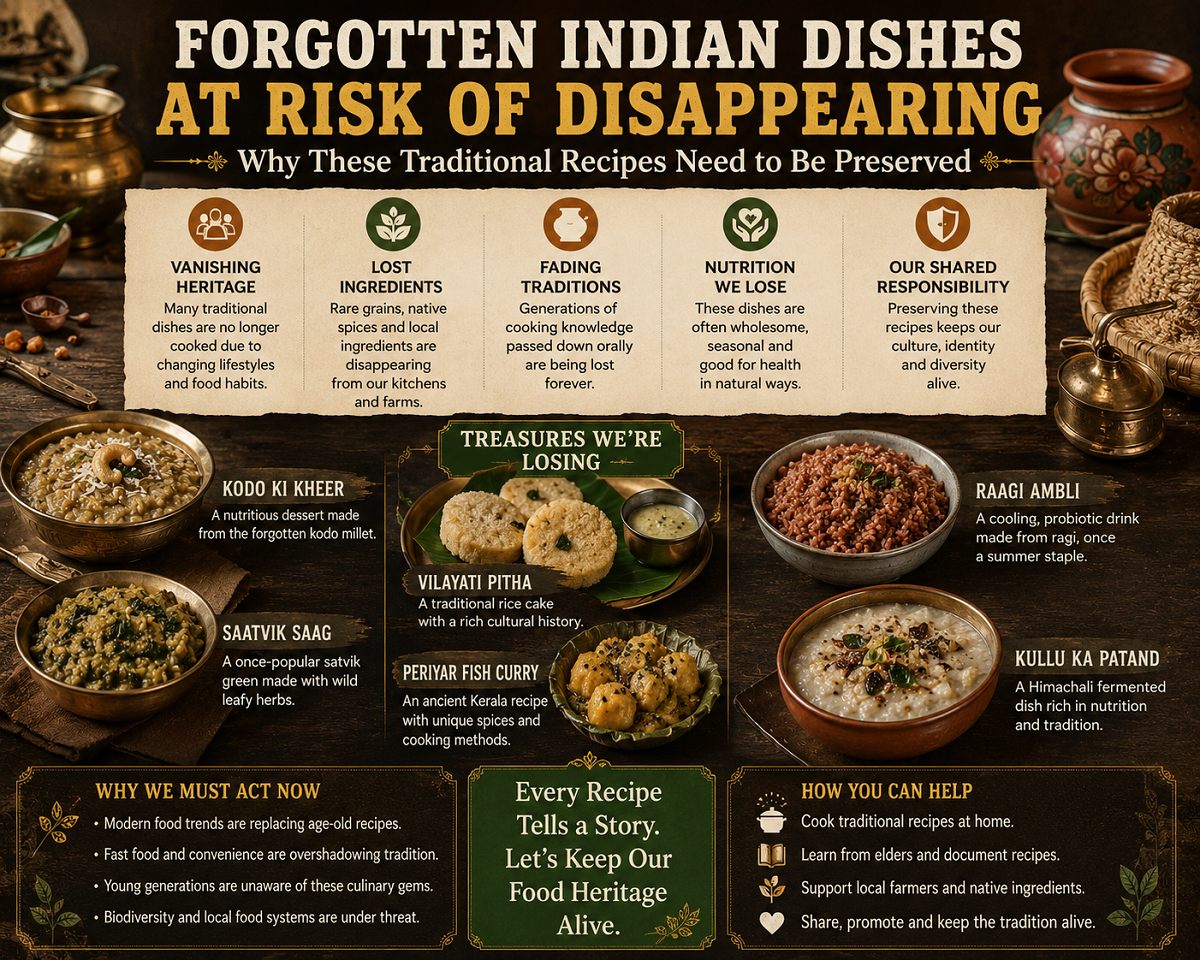
India's food culture is often celebrated for its extraordinary variety. Travel a few hundred kilometres and the ingredients, spices, breads, vegetables and cooking techniques can change dramatically. Yet behind the popularity of biryani, dosa, butter chicken and other widely recognised foods lies another side of Indian cuisine: traditional dishes that are slowly disappearing from household kitchens.
A recipe rarely vanishes suddenly. It usually starts with fewer families preparing it. Then an ingredient becomes difficult to find, the cooking process feels too time-consuming, or younger generations simply never learn the method. Eventually, a dish that once appeared regularly at festivals, weddings or seasonal meals may survive only in the memories of older family members.
The disappearance of such foods represents more than the loss of a recipe. Traditional cooking can preserve knowledge about local crops, seasonal ingredients, preservation techniques and community history. Once that chain breaks, recreating the original dish can become surprisingly difficult.
How Does a Traditional Dish Become Almost Extinct?
Imagine a recipe that has been prepared in one region for generations.
A grandmother knows exactly how to make it, but she never writes down the recipe because she learned it by watching her mother. Her children move to cities and prepare the dish only occasionally because it requires several hours of work.
The grandchildren recognise its name but never learn how to cook it.
Within a few generations, the recipe can effectively disappear.
Changing lifestyles are therefore one of the biggest challenges facing traditional food.
Modern households often have less time for elaborate preparation. Ready-to-eat foods, restaurant deliveries and ingredients available throughout the year have also changed how families decide what to cook.
Madhya Pradesh Has Documented Disappearing Food Traditions
The problem isn't merely theoretical.
Reports concerning efforts by Madhya Pradesh's cultural authorities have highlighted a large number of regional preparations that have either disappeared or become increasingly difficult to find.
Among the factors associated with this decline are changing food preferences, limited availability of traditional ingredients and labour-intensive cooking techniques.
Several dishes and preparations mentioned in discussions of disappearing regional cuisine include gulgula, raskhir, paudapitha, chusela and kola ki kheer, along with recipes involving traditional leafy greens.
Some names may be unfamiliar even to people living outside the communities where they originated.
That itself demonstrates how geographically fragile a food tradition can become.
Ingredients Can Disappear Before the Recipe Does
Saving an old recipe in a cookbook doesn't necessarily mean the dish has been preserved.
You also need its ingredients.
Suppose a traditional preparation requires a particular variety of grain, wild green, local fruit or freshwater fish. If farmers stop cultivating that crop or the fish becomes difficult to obtain, knowing the cooking instructions alone may not be enough.
This challenge has been observed in regional cuisines including Bengal's rich fish-cooking traditions.
Some older fish preparations become difficult to reproduce authentically when the species traditionally associated with the dish is no longer commonly available in local markets.
At the same time, changes in agriculture and food distribution introduce new ingredients, gradually reshaping what households cook.
The recipe may technically survive while its original version quietly disappears.
Forgotten Greens Are Another Part of the Story
Traditional Indian cooking once made extensive use of locally available leafy vegetables, including seasonal and sometimes wild greens.
These ingredients were often deeply connected to a particular landscape.
As supermarkets and standardised vegetable supply chains become more important, households may increasingly purchase the same limited selection of vegetables throughout the year.
When demand for an unusual local green falls, fewer sellers stock it. When availability falls, fewer people cook it.
Eventually, younger generations may not even recognise the ingredient.
Preserving regional cuisine therefore requires attention not only to recipes but also to local agricultural biodiversity.
Royal Kitchens Lost Recipes Too
Disappearing dishes aren't limited to rural or tribal food traditions.
India's royal kitchens also produced elaborate preparations whose exact recipes were sometimes closely guarded.
Awadhi cuisine provides an interesting example.
Historically, specialist cooks could possess techniques known only within particular kitchens or families. Unlike a modern restaurant where recipes may be documented and standardised, culinary knowledge was frequently transmitted directly from one cook to another.
If that knowledge wasn't passed on, the original method could disappear with the person who possessed it.
Modern chefs, culinary researchers and home cooks have attempted to reconstruct some historical preparations using old records, oral accounts and experimentation.
But reconstruction isn't always the same as preserving an uninterrupted tradition.
Why Younger Generations Are Cooking Some Dishes Less Often
Convenience plays a major role.
A traditional preparation might require soaking ingredients overnight, grinding them manually, preparing several components separately and then cooking everything slowly.
Compare that with a meal that can be prepared in 20 minutes.
For a household balancing work, education and commuting, the faster option naturally becomes attractive.
Another factor is migration.
When families move from villages or small towns to major cities—or overseas—they may lose easy access to ingredients that were readily available back home.
Eventually, the recipe gets adapted or disappears from regular meals.
Restaurants Cannot Save Everything
One possible solution is to introduce forgotten dishes in restaurants. That can certainly increase awareness, but commercialisation isn't always the answer.
Some traditional foods were never designed to be restaurant dishes.
They may be seasonal preparations cooked only during a particular festival or harvest. Others may require inexpensive local ingredients but extensive preparation, making them commercially unattractive.
That is why family kitchens remain one of India's most important culinary archives.
A handwritten notebook containing a grandmother's recipes can sometimes preserve knowledge that doesn't exist in any published cookbook.
How Can India's Disappearing Recipes Be Preserved?
Preservation doesn't necessarily require expensive projects. Families and communities can start by documenting what they already know.
Older family members can be asked to demonstrate traditional recipes while younger relatives record the ingredients, quantities and cooking process. Videos can be particularly valuable because techniques such as kneading, grinding, roasting or determining the correct consistency are difficult to explain through written instructions alone.
Regional food festivals and culinary documentation projects can introduce forgotten foods to younger audiences.
Farmers and local communities can also play an important role by continuing to cultivate traditional grains, vegetables, fruits and other indigenous ingredients.
Schools, culinary institutes, chefs and food researchers can help document the historical context surrounding these recipes.
Most importantly, however, people need to continue cooking them.
Traditional Recipes Are Also Historical Records
Food can tell us how earlier generations lived.
A millet preparation can reveal which crops were suited to a region's climate. A fermented dish may demonstrate how people preserved or transformed food without refrigeration. A seasonal sweet can explain agricultural cycles and festival traditions.
Even the cooking equipment used for a dish can reveal something about everyday life.
When such recipes disappear, part of that cultural information disappears with them.
The Bottom Line
Dishes such as gulgula, raskhir, paudapitha, chusela, kola ki kheer and numerous regional preparations involving local greens, grains and fish highlight a much larger challenge facing Indian culinary heritage.
Recipes disappear when people stop cooking them, ingredients become unavailable and knowledge is no longer transferred from one generation to another.
Saving India's culinary diversity doesn't mean every forgotten dish needs to become a restaurant trend or packaged product. Sometimes preservation can begin with something much simpler: asking an older family member how a traditional dish was made, writing down the recipe and cooking it again.
A forgotten recipe starts returning to life the moment another generation learns how to prepare it.