Technology
New SIM Card Rules From August 24: Users With 9 Active Connections Won’t Get Another Number
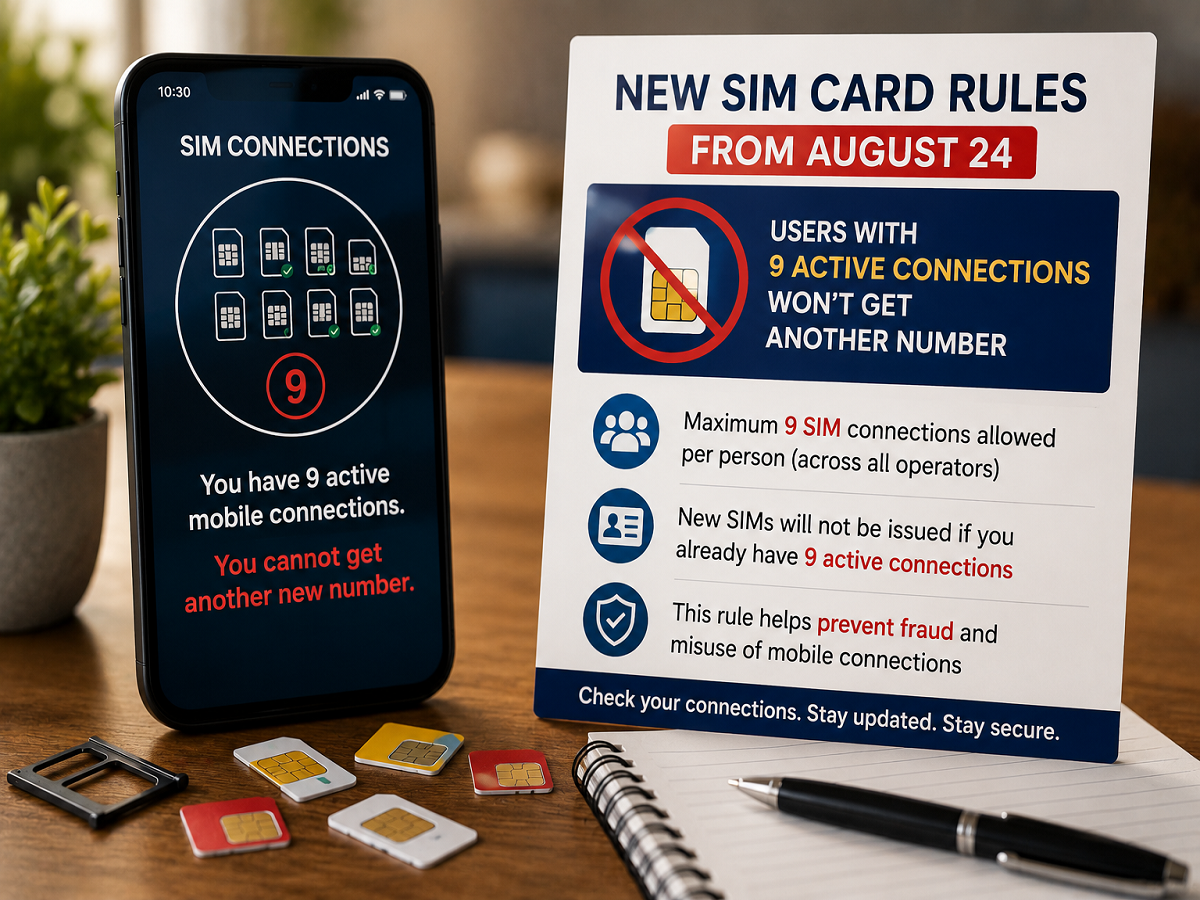
Mobile users in India need to be aware of an important change in SIM-card verification. The Department of Telecommunications (DoT) has directed telecom operators to strengthen checks so that an individual who has already reached the permitted limit of mobile connections cannot obtain another SIM.
Under the new enforcement mechanism, telecom companies will have to identify customers who already have nine mobile connections registered in their name and refuse an additional connection. The new technical and organisational measures are set to take effect from August 24, 2026.
The move is aimed at preventing fraudulent SIM issuance, misuse of identity documents and telecom-enabled cybercrime. For ordinary users, it also makes it more important to check whether any unknown or unused mobile numbers are registered against their identity.
What Exactly Is Changing From August 24?
The key change is stricter enforcement at the time a customer applies for another mobile connection.
DoT has asked telecom service providers to put systems in place to identify whether an applicant has already reached the prescribed maximum number of connections. If nine connections are already registered in the subscriber's name, the application for another SIM will be rejected.
In other words, repeatedly approaching different telecom operators will not provide a way around the limit because the verification mechanism is designed to check connections registered across operators.
How Many SIM Cards Can One Person Have?
For most of India, an individual can have up to nine mobile connections in their name.
There are stricter limits in certain regions. Reports on the DoT framework indicate that the maximum is six connections in Jammu & Kashmir, Assam and the North-East licensed service areas.
Therefore, users should not assume that the nine-connection limit applies uniformly in every telecom circle.
Already Have 9 Numbers? A New SIM Can Be Refused
Suppose you have accumulated several connections over the years—perhaps personal numbers, work numbers, secondary data SIMs and older numbers that you no longer use.
If nine active mobile connections are already registered against your identity, the telecom operator will be required to decline an application for another connection under the strengthened system.
This makes it particularly important to identify old connections that you may have stopped using but that remain registered in your name.
What Happens If an Extra SIM Is Issued?
The new framework also addresses situations where a connection is issued despite the subscriber having crossed the prescribed limit.
Recent reports on the DoT directions say that if an additional connection is mistakenly issued beyond the limit, the latest connection may be suspended within 24 hours.
The customer would then need to bring the number of connections within the permitted limit before obtaining another SIM.
Digital Intelligence Platform Will Strengthen Verification
A major part of the new enforcement mechanism involves DoT's Digital Intelligence Platform (DIP).
Telecom operators are being directed to use this system to identify subscribers who have already reached the maximum number of permissible connections. The platform is intended to make it harder for someone to obtain multiple connections from different operators while circumventing the prescribed limit.
According to current reports, records relating to subscribers who already have nine connections are being incorporated into the system, while telecom operators have been given until November 30, 2026 to complete broader system integration requirements.
Why Is DoT Tightening SIM Verification?
Mobile numbers have become closely connected with banking, UPI, social-media accounts, government services, OTP authentication and digital identity.
Fraudsters can misuse SIM cards obtained through fake, stolen or manipulated identity documents for phishing, impersonation and other cybercrimes.
Limiting the number of connections and improving cross-operator verification can make large-scale misuse of SIM cards more difficult.
DoT's existing documentation already contains restrictions relating to the number of mobile connections that can be associated with an individual in specified circumstances. (Department of Telecommunications)
The latest move strengthens the technical enforcement of these limits.
What If Unknown SIM Cards Are Registered in Your Name?
This is potentially more serious than simply being unable to obtain another SIM.
Someone may discover that a mobile connection they have never used is registered against their identity. Such a connection could have been created because of identity misuse or could simply be an old number the subscriber has forgotten about.
DoT provides a facility that allows consumers to check mobile connections issued in their name. Its telecom services information specifically describes this facility as a way for users to identify connections and help prevent fraud. (eServices)
If you find a number that does not belong to you, it should be reported through the appropriate official mechanism.
Check Mobile Numbers Registered in Your Name
Consumers can use the government's telecom verification services to review mobile connections linked with their identity.
Department of Telecommunications eServices Portal
Checking the list can be particularly useful before applying for another SIM if you have used several mobile connections over the years.
If an old connection is no longer required, follow the operator's prescribed procedure for closing it rather than simply leaving the SIM unused.
Does Having 9 SIMs Mean Your Existing Numbers Will Be Blocked?
Not automatically.
The important distinction is between already having connections within the permitted limit and attempting to obtain another one beyond that limit.
A customer who legitimately has nine active connections does not lose all those numbers merely because the new enforcement mechanism takes effect. The immediate consequence is that another connection should not be issued while the subscriber remains at the maximum permissible limit.
Different rules can apply where connections are found to be fraudulent, unauthorised or above the permitted limit.
What Mobile Users Should Do Now
Consumers who use only one or two mobile numbers are unlikely to notice any practical difference. The rule is more relevant for people who have accumulated multiple SIM cards over time.
Check how many connections are registered in your name, identify numbers you no longer recognise or use, and report suspicious connections through official DoT channels. If you already have nine active connections and genuinely need another number, you may first need to reduce the number of existing connections within the applicable limit.
New Rule Is Mainly About Fraud Prevention
The August 24 change should not be interpreted as a general restriction on ordinary mobile users. Instead, DoT is strengthening the mechanism used by telecom operators to enforce the existing ceiling and prevent people from obtaining connections beyond the prescribed limit.
For consumers, the development is also a useful reminder to regularly check which mobile numbers are registered against their identity.
With mobile numbers now connected to everything from banking and Aadhaar-linked services to messaging and account recovery, an unknown SIM operating in your name can represent a serious security risk. Checking your registered connections now could therefore prevent problems later.