
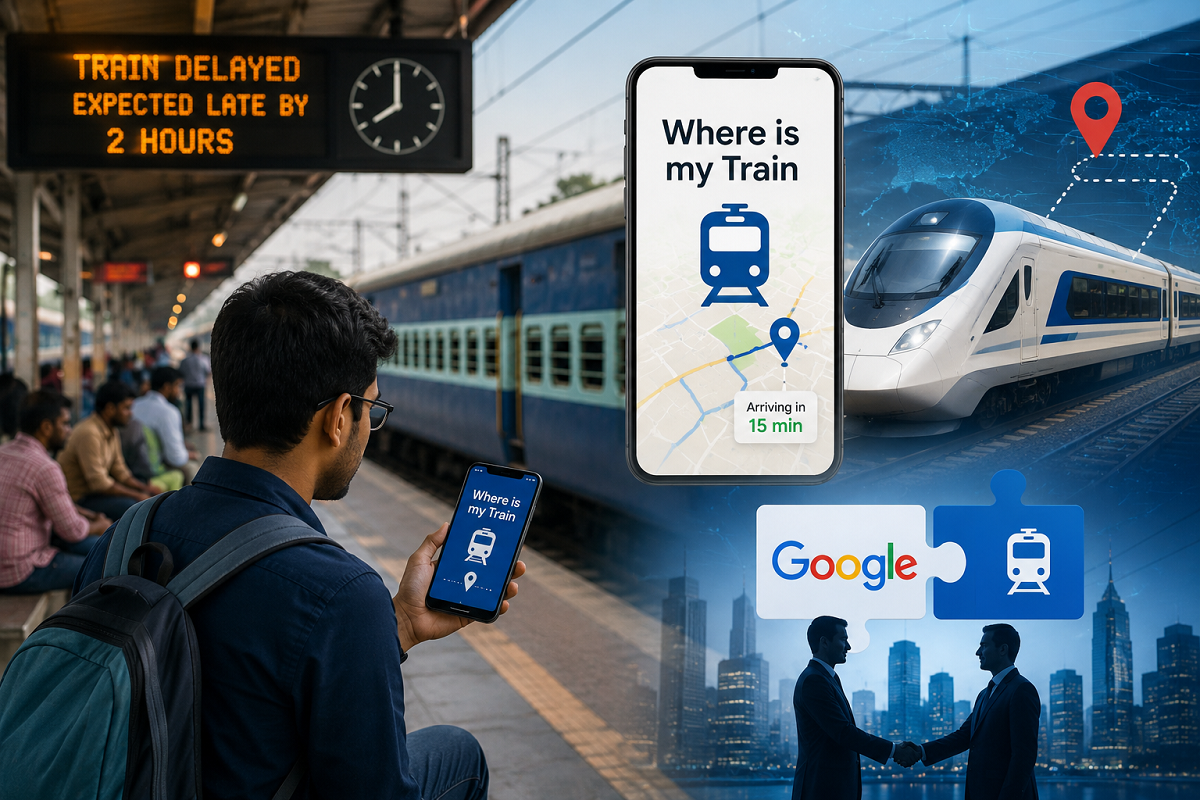
A delayed train and the uncertainty of not knowing when it would arrive may seem like an everyday inconvenience. But for Ahmed Nizam Mohaideen and his team, that familiar problem eventually became the foundation of one of India’s most popular railway tracking apps.
The app, called Where Is My Train, was designed to make it easier for passengers to find out where their train was and when it was likely to reach a station. What began as a practical attempt to solve a common railway travel problem later attracted the attention of Google, which acquired the company behind the app, Sigmoid Labs, in 2018.
Several media reports have estimated the value of the transaction at around ₹280 crore, although Google did not officially disclose the acquisition price. Reports at the time placed the deal in the range of roughly $30 million to $40 million.
How a Common Railway Problem Turned Into an App Idea
Millions of people depend on Indian Railways, but tracking a delayed train was once considerably more difficult than it is today. Passengers often had to depend on station announcements, enquiry counters or incomplete information to understand where their train had reached.
Ahmed Nizam and his team saw an opportunity in this everyday inconvenience. Instead of treating train delays and uncertain arrival times as unavoidable, they worked on a technology-based solution that could provide useful train information directly on a passenger’s smartphone.
The project eventually developed into Where Is My Train, which was launched in the middle of the last decade. Its basic purpose was simple: help passengers check train location and other journey-related information without requiring a complicated process.
The App’s Offline Tracking Feature Made It Stand Out
One of the biggest challenges for railway passengers in India is unreliable mobile connectivity along long-distance routes. Trains frequently pass through rural areas, tunnels and regions where internet access may be weak or unavailable.
Where Is My Train addressed this issue in an innovative way.
The app was designed to use mobile cell-tower information to estimate a train’s location during a journey. This allowed passengers to access important tracking information even when regular internet connectivity was limited. The technology became one of the key features that differentiated the app from many conventional train-tracking services.
The app also offered information such as train schedules, delays and station details, making it particularly useful for passengers trying to plan their journey.
Popularity Grew Rapidly Among Indian Rail Passengers
A technology product becomes valuable when it solves a real problem, and Where Is My Train addressed an issue experienced by a huge number of people.
As more passengers discovered the app, its user base expanded rapidly. By the time Google acquired Sigmoid Labs in December 2018, the app had already recorded around 10 million downloads and had established itself as one of the better-known railway information apps in India.
The service continued expanding after the acquisition. A presentation associated with Nizam later described the app as having crossed 100 million downloads and becoming a leading travel application on the Google Play Store.
Google Acquired the Team Behind Where Is My Train
The app’s success eventually attracted Google.
In December 2018, Sigmoid Labs announced that its team was joining Google. In its announcement, the company said the move would allow it to continue working toward its goal of using technology to improve the lives of Indian train travellers.
Reports from the time said the Sigmoid Labs team would become part of Google’s efforts to create products and services suited to users in India and other emerging markets. The official terms of the transaction, however, were not made public.
That detail is important because the widely circulated figure of ₹280 crore should be treated as a reported estimate rather than a confirmed acquisition price.
Why Google May Have Found the App Attractive
Where Is My Train had several characteristics that made it particularly relevant to the Indian market.
It solved a widespread transportation problem, was simple to use and could remain useful even in places with limited connectivity. Rather than depending completely on high-speed internet or constant GPS access, its approach was designed around the real-world conditions faced by railway travellers.
The company behind the product was also relatively small. Contemporary reports described Sigmoid Labs as having a team of around 10 people when it joined Google.
This demonstrated how a focused team solving a clearly defined problem could create a product capable of reaching millions of users.
A Small Problem Can Lead to a Large Technology Product
The story of Where Is My Train is a strong example of problem-driven innovation.
The idea did not begin with an attempt to create an enormous technology company. Instead, it focused on a question familiar to railway passengers: Where is the train, and when will it arrive?
By designing around actual passenger behaviour, connectivity limitations and the scale of India’s railway network, the team created a service that became useful to a massive audience.
The journey from a railway travel problem to an acquisition by one of the world’s largest technology companies also highlights an important lesson for entrepreneurs: successful products do not always begin with complicated ideas. Sometimes they begin by making an everyday task significantly easier.
The Bottom Line
Where Is My Train transformed a routine frustration faced by railway passengers into a widely used technology product. Ahmed Nizam Mohaideen and his team developed an app capable of helping travellers track trains even when internet connectivity was unreliable.
Its growing popularity eventually led Google to acquire Sigmoid Labs in 2018. While reports have valued the transaction at around ₹280 crore, the exact financial terms were never officially disclosed.
More than anything, the app’s journey shows how understanding a real consumer problem and solving it simply can turn a small idea into a product used by millions.