
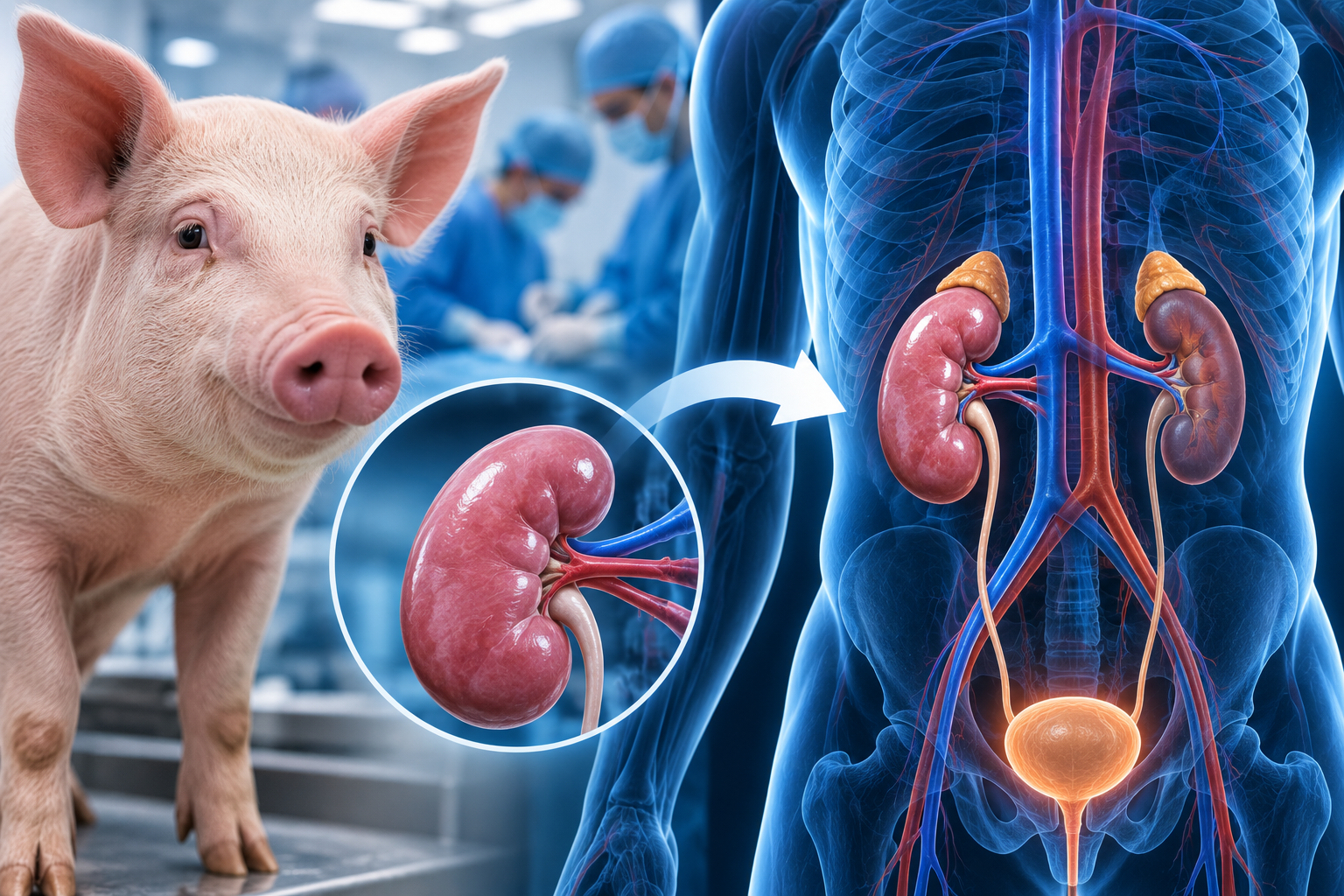
A remarkable experiment in transplant medicine has demonstrated how a genetically modified pig kidney could potentially serve as a temporary lifeline for people waiting for a human donor organ.
Tim Andrews, a 66-year-old patient with end-stage kidney disease, lived with a genetically engineered pig kidney for 271 days without requiring dialysis. After the pig kidney was eventually removed, Andrews returned to dialysis for a limited period before receiving a donated human kidney in January 2026.
His case has now been detailed by researchers from Massachusetts General Hospital in a paper published in The Lancet, highlighting the potential for animal-to-human transplantation, known as xenotransplantation, to act as a bridge while patients wait for human organs.
Tim Andrews Received a Pig Kidney in January 2025
Andrews had been living with end-stage kidney disease and had spent more than two years undergoing dialysis before doctors offered him an experimental pig-kidney transplant.
The surgery was performed at Massachusetts General Hospital on January 25, 2025.
Doctors transplanted a genetically modified pig kidney containing 69 genomic edits, designed to make the organ more compatible with the human immune system.
Following the operation, Andrews was able to stop dialysis and return to many activities that had become difficult while receiving regular treatment.
Mass General Brigham says the kidney supported him for 271 days without dialysis.
What Is Xenotransplantation?
The procedure Andrews underwent is known as xenotransplantation.
The term refers to transplanting living cells, tissues or organs from one species into another. In this case, a kidney from a genetically engineered pig was transplanted into a human recipient.
Scientists have studied pigs extensively as potential organ donors because several pig organs are reasonably similar in size and function to their human counterparts.
But an ordinary pig organ cannot simply be transplanted into a person.
The human immune system recognises animal tissue as foreign and can rapidly attack it, causing severe rejection.
Modern genetic engineering is being used to overcome some of those biological barriers.
Why Was the Pig Kidney Genetically Modified?
The kidney used in Andrews' operation came from a specially engineered donor pig developed by biotechnology company eGenesis.
Scientists used CRISPR-based genetic technology to alter the animal's genome.
The kidney carried 69 genetic modifications. These edits were intended to remove certain pig genes that could provoke rejection, introduce human genes that improve compatibility and address other biological risks associated with transplantation.
These changes are one of the main reasons researchers believe pig organs may eventually become more suitable for use in humans.
The procedure remains experimental, however, and patients still require careful medical monitoring and medicines that suppress immune rejection.
Pig Kidney Allowed 271 Days Without Dialysis
One of the most significant outcomes of Andrews' case was the amount of time he could remain away from dialysis.
For 271 days—nearly nine months—the transplanted kidney performed enough renal function that he did not need dialysis.
Dialysis can be demanding for patients with kidney failure, often requiring repeated sessions every week to remove waste products and excess fluid from the blood.
A functioning transplant can therefore make a major difference to everyday life.
Andrews' experience provided researchers with valuable evidence that a genetically engineered pig kidney could support a living patient for many months rather than merely days or weeks.
Why Was the Pig Kidney Eventually Removed?
The transplant was not permanent.
After several months, doctors began observing problems affecting the kidney.
The source report says that vascular injury developed over time and kidney function eventually declined, requiring surgeons to remove the organ in October 2025.
Andrews then had to return to dialysis.
Researchers are studying cases such as this to better understand chronic rejection, immune responses and other biological changes that could limit how long animal organs remain functional.
This is one of the biggest challenges that scientists must solve before pig kidneys could become a routine alternative to human donor organs.
Pig Kidney Became a 'Bridge' to Human Transplant
The most important aspect of Andrews' case may be what happened next.
After the pig kidney was removed, he spent 82 days back on dialysis before receiving a kidney from a deceased human donor in January 2026.
The human kidney transplant was successful, according to the medical team.
This made Andrews the first reported patient to move from a pig-kidney xenotransplant to a human kidney transplant, demonstrating what researchers describe as a possible “bridge-to-transplant” strategy.
Instead of remaining on dialysis continuously for years while waiting for a donor, some patients could potentially receive an animal kidney temporarily and later transition to a human organ when one becomes available.
Can a Pig Kidney Keep a Human Alive Permanently?
The 271-day result does not establish a fixed lifespan for pig kidneys transplanted into humans.
There is currently no scientifically established rule saying that a genetically modified pig kidney will work for a particular number of days, months or years in every patient.
Xenotransplantation is still developing, and outcomes depend on immune rejection, genetic modifications, immunosuppressive treatment, infections, the patient's overall health and other factors.
Importantly, Andrews' 271-day period should also not be described as the current universal record for how long any pig kidney has functioned in a living human. By early September 2026, another Mass General recipient had reportedly passed nine months with a functioning pig kidney, showing how quickly the field is advancing.
Why Could Pig Kidneys Become Important?
The biggest reason researchers are pursuing xenotransplantation is the shortage of human donor organs.
Thousands of patients spend years waiting for kidney transplants while depending on dialysis to survive.
Unlike human organs, genetically engineered donor pigs could theoretically provide a more predictable supply of kidneys if researchers can establish long-term safety, effectiveness and reliable manufacturing standards.
That could potentially reduce waiting times and give doctors another treatment option for selected patients with severe kidney failure.
However, much larger clinical studies will be necessary before these procedures can become routine.
The 271-Day Case Is an Important Step, Not a Final Answer
Tim Andrews' experience offers promising evidence that genetically engineered pig kidneys may eventually help bridge the gap between kidney failure and human transplantation.
His pig kidney kept him free from dialysis for almost nine months before declining, after which he successfully transitioned to a human donor kidney.
Researchers now need to determine whether future gene-edited pig organs can function safely for substantially longer periods and whether the approach can be reproduced across larger groups of patients.
For now, the case represents an important milestone in xenotransplantation—but not proof that pig kidneys can permanently replace human donor kidneys.
Disclaimer: This article is for general informational purposes only. Xenotransplantation remains a highly specialised and experimental medical procedure and is not a routine treatment for kidney failure.